
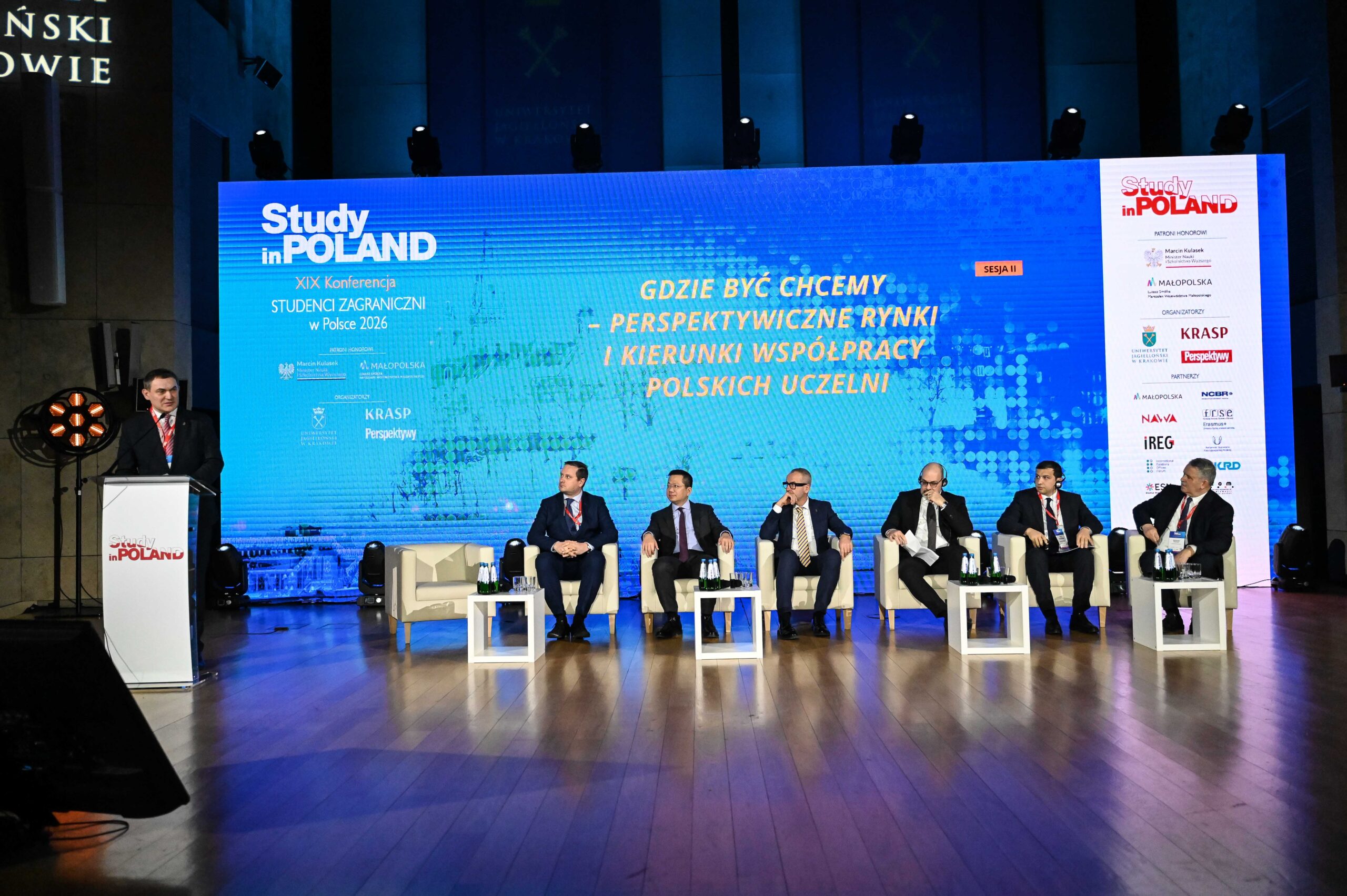
From 28–30 January, the Auditorium Maximum of the Jagiellonian University hosted the conference Foreign Students in Poland 2026 – one of the key events dedicated to the internationalisation of Polish higher education. Representatives of academia, public administration, and diplomacy discussed the future of international students in a changing geopolitical landscape.
The Study in Poland conference is one of the most important events in the country devoted to international students and the internationalisation of higher education. It brought together representatives of the academic community, public administration, diplomacy, the military, business, and institutions responsible for the country’s migration and science policies. The event is organised as part of the Study in Poland programme, run jointly by the Conference of Rectors of Academic Schools in Poland and the Educational Foundation “Perspektywy”. Around 60 academic universities participate in the conference each year.
The host of the event was Prof. Piotr Jedynak, Rector of the Jagiellonian University, who said while opening the conference:
– There is no better opportunity for truly strategic reflection on the state of internationalisation – its directions, the challenges it faces, and the tools we should be using. What undoubtedly constitutes a particular value of our meetings is, on the one hand, an open dialogue that also involves representatives of the regulatory sphere, and on the other, the constant deepening of knowledge about internationalisation. Today, during the press conference, we had proof of this in the form of the first supplementary report in the history of our meetings, prepared by the University of Economics in Katowice, which presents the economic impact of the presence of international students in Poland.
The guest of honour at the conference was Prof. Andrzej Szeptycki, Undersecretary of State at the Ministry of Science and Higher Education, who emphasised the importance of the government’s recent actions from the perspective of internationalisation – including the introduction of the visa act, the migration strategy, and the Polish diaspora strategy.
Among the distinguished speakers and debate participants were, among others: Prof. Piotr Jedynak – Rector of the Jagiellonian University; Prof. Marek Pawełczyk – Chair of the KRASP Committee for International Cooperation and Rector of the Silesian University of Technology; Dr Bianka Siwińska – President of the Educational Foundation “Perspektywy”; Prof. Maciej Duszczyk – former Undersecretary of State at the Ministry of the Interior and Administration; Prof. Krzysztof Pyrć – President of the Foundation for Polish Science; Col. Piotr Turek – Head of the Artificial Intelligence Implementation Centre at the Cyber Defence Forces Component Command; Robert Sadowski – President of the Management Board of Zakłady Mechaniczne “Tarnów” S.A. (PGZ Group); and Prof. Grzegorz Mazurek – Rector of Kozminski University and Member of the Supervisory Board of PKO BP.
An important moment of the conference was the presentation of the first-ever report on the economic impact of international students in Poland, prepared by the University of Economics in Katowice – a document that introduces solid data and a new perspective to the debate. According to the report, in the 2024/2025 academic year 108,609 international students from 179 countries studied in Poland. Compared with the previous year, this represents an increase of 1,479 students (1.4%). International students accounted for 8.5% of all students in Poland.
As the report indicates, the Polish education market continues to attract international students, particularly from Ukraine and Belarus. In the 2024/2025 academic year, the number of students from Ukraine reached 47,541, an increase of 1,331 compared with the previous year, while the number of students from Belarus decreased to 12,221, still representing a significant share of the total.
Poland’s attractiveness results from the quality of education, a wide range of study programmes, as well as factors such as geographical proximity, Poland’s membership of the European Union, and cultural similarities. In the 2024/2025 academic year, the third largest group of foreign students came from Turkey (5,158 students), while fourth place was taken by students from Zimbabwe (3,446 students).
Interest in studying in Poland has also grown in Asia. In the 2024/2025 academic year, the number of Asian students at Polish universities increased by 2%. Students arrived in Poland from China (2,551) and Taiwan (435), among others. Compared with the previous year, the number of students from Nepal, the Philippines, and Mongolia increased. The number of students from Azerbaijan and Kyrgyzstan remained at a similar level. Growth was also observed among students from African countries such as Tanzania, Kenya, Congo, and South Africa. For the first time, students from the Cayman Islands and East Timor began their studies at Polish universities. As in previous years, the most popular fields of study among international students were management, computer science, and medicine.
A particularly significant session was devoted to prospective directions of international cooperation, with the participation of H.E. Rauf Alp Denktaş, Ambassador of Turkey to Poland; Siroj Sayfulloev, Political Counsellor at the Embassy of Uzbekistan in Poland; and H.E. Hà Hoàng Hải, Ambassador of Vietnam. The session demonstrated how important it is today to build long-term relationships based on trust, quality, and mutual benefit.
– Poland is an attractive destination for students from Uzbekistan due to the high quality of European education, affordable tuition fees, and globally recognised diplomas. Universities such as the Jagiellonian University offer a wide range of programmes in English, while Poland’s central location in Europe provides valuable academic opportunities. Moreover, Poland’s central position allows easy travel across the EU and contact with diverse cultures – noted Siroj Sayfulloev.
The Ambassador of Vietnam also emphasised that sending students abroad is extremely important for Vietnamese society. He stressed that students gain a solid education abroad and then return to their country, gradually expanding the relatively small circle of national elites by taking on high public offices. He himself is a good example of this path.
Rectors of Polish universities also actively joined the discussion on strategic directions of internationalisation, emphasising the need to move consistently from declarations to concrete, long-term institutional actions. The Rector of the University of Gdańsk, Prof. Piotr Stepnowski, said:
– Today, internationalisation is no longer an addition to a university’s strategy but one of the key factors in the development of higher education. That is why it is so important that, instead of dispersed activities, we focus on selected directions of cooperation and build relationships based on quality, mutual trust, and long-term projects that bring real benefits. The key is to move effectively from declarations to concrete actions and to design international cooperation in a strategic way. Turkey and Morocco are excellent partners with whom we should develop research, educational, and institutional cooperation at an even higher level. The University of Gdańsk has recently signed two agreements with leading Turkish universities – Istanbul University and Istanbul Technical University – aimed at developing research cooperation between universities in both countries. This year we will also host the Second Forum of Rectors of Polish and Turkish Universities, which will help strengthen cooperation both between universities and between our two countries.
A similar tone was heard in the speech of the Rector of Kozminski University, Prof. Grzegorz Mazurek, representing a private university, who emphasised the importance of quality, selectivity, and building a strong international brand as the foundation for further development:
– This is a good moment for Poland – we are generating positive emotions and increasingly showing that it is a place where one can develop academically and professionally. We also see that the regulatory environment supports a more quality-oriented internationalisation. That is why, as universities, we invite the best students, researchers, and partners who want to co-create value. At Kozminski University, internationalisation is not an end in itself – it is a tool for strengthening the quality of education, the potential of research, and the competencies of graduates in a global world. We therefore build our strategy around partnerships, programmes, and experiences that translate into tangible benefits for people and the economy.
Among the key challenges currently facing Polish universities – as emphasised by many conference speakers – are improving the quality of scientific and academic cooperation and effectively recruiting the best candidates for bachelor’s and master’s studies, as well as for doctoral schools. Participants agreed that these efforts require focusing on selected countries and building durable, strategic relationships based on mutual benefits, trust, and high standards of cooperation.
Several years ago, the Polish academic community identified the most promising directions of internationalisation for the coming years. The priority partners include Turkey, Uzbekistan, Vietnam, and Morocco.
One of the countries where real opportunities for such cooperation can already be seen is Morocco, emphasised Tomasz Orłowski, head of the Polish diplomatic mission in the Kingdom of Morocco and Mauritania.
– Morocco is a country that consistently and strategically invests in the development of human capital. We clearly see a strong emphasis on improving the quality of education and creating elite educational paths that respond to the country’s development needs. In this context, we see a real opportunity to increase the number of Moroccan students undertaking high-level studies in Poland. Our goal is to develop cooperation in the area of specialised studies, particularly master’s and postgraduate programmes leading to a double degree.
Following the KRASP mission held in November in Rabat and Casablanca, the first agreement establishing a double-degree programme was signed between the Silesian Medical University and Mohammed V University. This is a concrete example of the cooperation model that the partners intend to develop further.
The first day of the conference concluded with a ceremonial gala in the unique setting of the Wieliczka Salt Mine. The event was not only an opportunity to summarise years of efforts towards internationalisation but also to present awards to the best international student in Poland in the INTERSTUDENT 2026 competition and the Internationalisation Stars 2026 awards. The gala dinner also provided an excellent space for meetings, conversations, and building relationships among people who actively shape the future of Polish science and higher education.
The conference Foreign Students in Poland 2026 confirmed that internationalisation has become one of the key pillars of the development of Polish higher education. The data presented, together with the voices of rectors and representatives of administration and diplomacy, clearly show that strategic actions based on quality and long-term partnerships are needed. Poland is consistently building its position as an attractive place to study and conduct research, attracting an increasingly diverse academic community from around the world. If this direction is maintained, the number of international students and international research projects will continue to grow, strengthening the competitiveness of Polish universities and the entire economy.
Ada Krzewicka