
From Courland to Żagań – The European Heritage of the Biron Dukes.
The history of the Church of the Holy Cross in Żagań is an extraordinary story of the legacy of the Biron family, Dukes of Courland. This remarkable monument is far more than a place of worship and a princely mausoleum. It stands as a testament to an era when diplomacy was conducted not only at conference tables but also in palace salons, through correspondence, private conversations, and meetings between individuals who shaped the course of European history.
The origins of this story lead to the Duchy of Courland and Semigallia, a fief of the Crown of the Kingdom of Poland, which during the eighteenth century became one of the leading cultural and political centres of Eastern Europe. A pivotal figure was Ernst Johann von Biron, father of the last Duke of Courland, Peter von Biron. He was a distinguished patron of the arts and culture and the owner of extensive landed estates and considerable wealth.
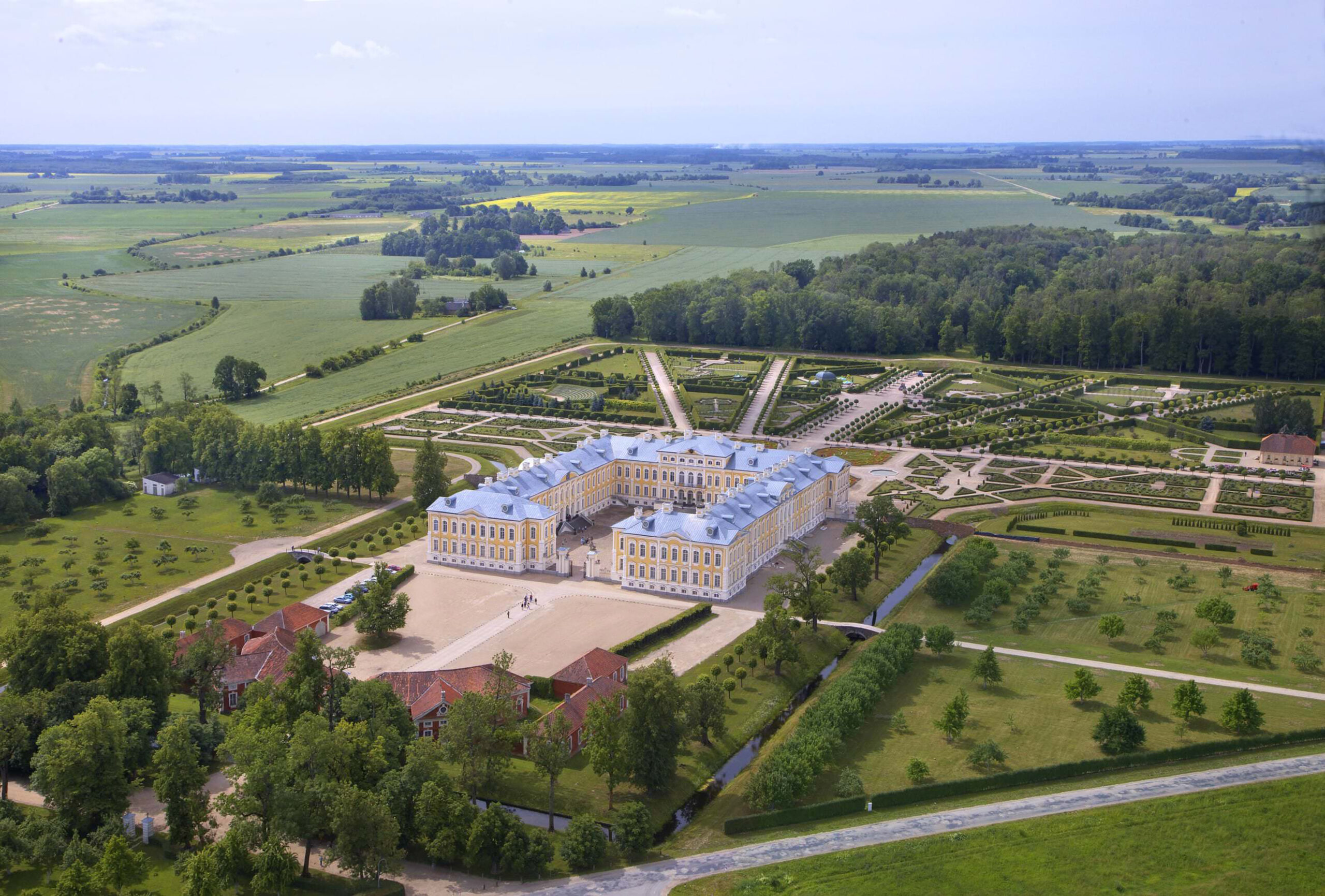
The family’s most magnificent residence remains Rundāle Palace, whose construction began in 1730 according to the designs of Bartolomeo Rastrelli, court architect to Empress Anna Ioannovna and creator of the celebrated Winter Palace in St Petersburg. Today, Rundāle is Latvia’s foremost Baroque palace and garden complex and hosts numerous international cultural events that highlight the shared heritage of Central and Eastern Europe.
By the end of the eighteenth century, the increasingly complex political situation between the Kingdom of Poland and the Russian Empire profoundly altered the fate of the Biron family. Duke Peter von Biron decided to establish a new family seat and, in 1786, acquired the Duchy of Żagań together with the estate of Otyń. Following the events connected with the Third Partition of Poland, he formally renounced his rights to the Duchy of Courland and Semigallia in 1795 while retaining the ducal title for his family.
Wilhelmine of Sagan – A Woman Who Helped Shape European Diplomacy
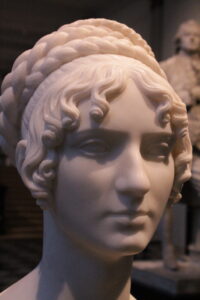
Peter von Biron’s eldest daughter, Wilhelmine von Sagan, became one of the most remarkable women of her generation. Highly educated, immensely wealthy, and exceptionally well connected throughout Europe, she played a significant role during the Napoleonic Wars.
Her influence extended far beyond aristocratic society. Wilhelmine established her own political salon, where members of Europe’s ruling and diplomatic elites gathered. Of particular importance was her residence at Ratibořice, where, in 1813, representatives of the anti-Napoleonic coalition held crucial discussions. Among those present were Tsar Alexander I of Russia, Prussian representatives, and Prince Klemens von Metternich.
Metternich, one of the nineteenth century’s foremost statesmen, fully appreciated the significance of the environment Wilhelmine had created. In a letter written in 1813, he observed:
“They say, my dear Wilhelmine, that Ratibořice will enter history. It is becoming the diplomatic centre of Europe at a time when poor Europe has become the place where all the world’s difficulties converge.”
Wilhelmine was also actively involved in preparations for the Congress of Vienna (1814–1815). Her salon at Vienna’s Palais Palm became an important meeting place for monarchs and diplomats responsible for shaping Europe’s post-Napoleonic political order.
Dorothea de Talleyrand-Périgord – Duchess of Europe’s Political Salons
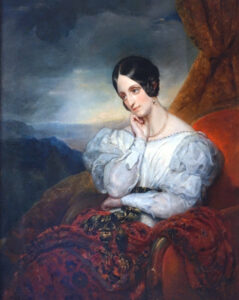
Another outstanding member of the Biron family was Wilhelmine’s younger sister, Dorothea von Biron, later Duchess of Dino and, from 1846, Duchess of Sagan. Her life exemplified the union of aristocratic heritage, exceptional education, and extraordinary diplomatic talent.
Raised within the traditions of European culture, Dorothea was fluent in German, French, and English. Her music teacher was the distinguished composer and pianist Franz Lauska, who also taught Giacomo Meyerbeer and Felix Mendelssohn. Among her tutors was Scipione Piattoli, secretary to the King of Poland.
Her close association with Charles-Maurice de Talleyrand-Périgord, France’s Foreign Minister and one of Europe’s greatest diplomats, brought her into the very heart of international politics. During the Congress of Vienna she supported France’s efforts to regain its position among the great European powers. Later, she participated in French diplomatic activity in London while maintaining extensive contacts with European royal courts.
Her exceptional standing was recognised in 1830 when King William IV of the United Kingdom conferred upon her the honorary title of Ambassadress. It was among the earliest and highest diplomatic distinctions ever granted to a woman in nineteenth-century Europe.
Dorothea also left remarkable memoirs describing the leading personalities of her age. In 1853 she wrote:
“I met and spoke with all the celebrated military leaders of my time. Beginning with Suvorov, who held me on his knees in Prague when I was seven years old, then Napoleon and his companions-in-arms, Wellington, Schwarzenberg, Blücher—in short, now that I have also come to know Radetzky, I have met all the great commanders of my age, and some of them, such as Napoleon and Wellington, even quite closely. These are unforgettable images that have remained vividly in my memory.”
The Church of the Holy Cross – An Overlooked Princely Heritage Site
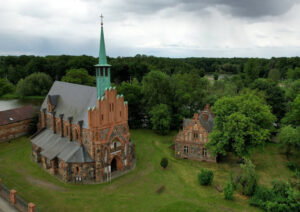
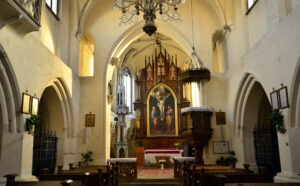
The most significant material testimony to the presence of the Courland princesses in Żagań, in western Poland, is the Church of the Holy Cross. Originally of medieval origin, the church was rebuilt in the Neo-Gothic style between 1849 and 1851 on the initiative of Duchess Dorothea.
The church was intended as the dynastic mausoleum of the family. Within its walls rest the two extraordinary sisters, Wilhelmine and Dorothea, whose lives left a lasting mark on the history of European diplomacy.
The architectural design and decorative programme were entrusted to Leonhard Dorst, architect, painter, and heraldic artist. The interior was enriched with works by the royal portrait painter Karl Begas of Berlin, stained-glass windows by Carl Samuel Scheinert of the Royal Porcelain Manufactory in Meissen, and sculptures by Bernhard Afinger, a pupil of Daniel Christian Rauch. One of the church’s most remarkable artistic features is its extensive use of natural ultramarine pigment, applied both inside and on exterior architectural details. During the nineteenth century, natural ultramarine was valued at nearly twice the price of gold.
The church also preserves outstanding movable heritage. Alongside the surviving princely sarcophagi, particular attention should be given to its pipe organ dating from around 1700, regarded as one of the oldest preserved organs in western Poland.
An Endangered Heritage and the Mission of the Association
After 1945 the monument entered a dramatically different chapter of its history. Between 1948 and 1965, the Polish state acquired the estates formerly belonging to the French branch of the Talleyrand family. The church became state property and for many years served as a hospital mortuary and storage facility. Much of its original furnishing was dispersed.
Since 1983, the church has been cared for by the Parish of St Joseph in Żagań. Since 2008, conservation, documentation, research, and restoration efforts have been undertaken by the Association for the Heritage of the Dukes of Żagań and Courland.
The Association’s mission has a truly European dimension. The Church of the Holy Cross represents a shared cultural heritage of Poland, France, Germany, the Czech Republic, Austria, the United Kingdom, Belgium, and Latvia. It stands as a symbol of a common European history that transcends national borders and reminds us of the continent’s shared cultural foundations.
Today, the monument in Żagań is not only the burial place of the Courland princesses but also a memorial to diplomacy, art, and the collective responsibility to preserve Europe’s historical legacy. Through the Association’s dedicated work, there is hope that this exceptional site will regain its rightful place among Europe’s most significant heritage monuments.
History on the Screen
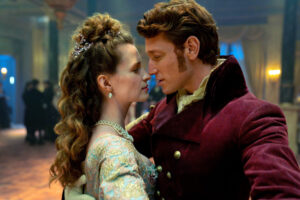
For many years, the life of Duchess Wilhelmine of Sagan has inspired filmmakers. Particular attention has focused on her activities in Vienna during the Congress of Vienna. According to the producers’ announcements, the historical television series Vienna Game, produced by SATEL Film, is scheduled to premiere in November 2026. One of its central storylines will feature Duchess Wilhelmine of Sagan, and the series is expected to be released on the Disney+ streaming platform.
Adam Raciborski
Stowarzyszenie na rzecz Dziedzictwa Książąt Żagańskich i Kurlandzkich