
In an era of rapidly advancing digital technologies and the growing prevalence of false and manipulative content in the information space, the ability to critically assess information has become one of the most important competencies of modern society. In response to this challenge, the Fejkoodporni Project was launched as a nationwide educational initiative organized by the Forum of Young Diplomats in cooperation with the Representation of the European Commission in Poland and the United Nations Information Centre in Warsaw. The project’s primary objective was to counter disinformation by educating young people, developing critical thinking skills, and strengthening safety in the digital environment.
The project consisted of a series of activities carried out across different regions of Poland. Through educational workshops organized for secondary school students in Warsaw, Poznań, Kraków, and the Pomeranian region, participants gained practical knowledge on identifying false information, verifying sources, recognizing manipulation techniques, and navigating the online environment safely. At the same time, an educational social media campaign was conducted to reach a broad audience of young people and raise awareness of the threats posed by disinformation.
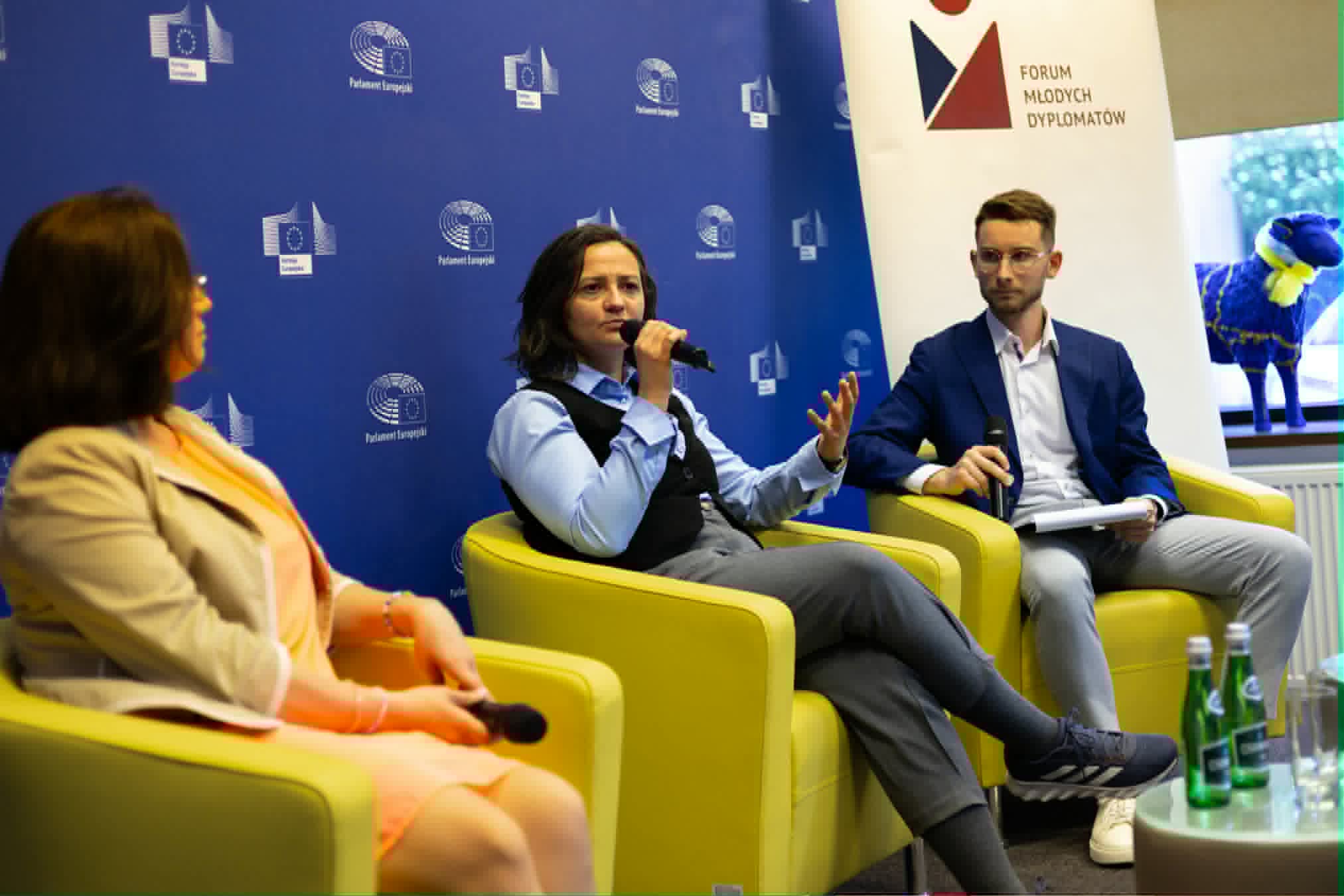
The project culminated in two conferences held in Wrocław and Warsaw. These events brought together experts, representatives of public institutions, non-governmental organizations, academia, and young people interested in information security and resilience.
The first event, entitled “With a View to the EU’s Resilience to Disinformation” was organized at the House of Europe in Wrocław. The conference was preceded by workshops during which participants became familiar with practical tools for identifying and countering information manipulation. This was followed by an expert panel devoted to Foreign Information Manipulation and Interference (FIMI) and Domestic Information Manipulation and Interference (DIMI) in the context of the European Union and Poland, the role of public institutions, local governments, and civil society in strengthening information resilience, as well as contemporary influence operations and methods of countering information manipulation.
The concluding conference of the project took place the following day at the headquarters of the Representation of the European Commission in Poland in Warsaw. The event featured experts representing, among others, Demagog, NASK, CyberDefence24, and academic institutions.
The first panel, entitled “How Do Fake News Stories Work and Why Do We Believe Them?”, focused on the psychological mechanisms underlying susceptibility to disinformation. Participants examined cognitive processes influencing the reception of information, discussed the most commonly used manipulation techniques, and presented practical methods for developing critical thinking skills and verifying information.
The second panel, “Social Disinformation as a Challenge for Contemporary Societies,” explored the impact of false information on society beyond the political sphere. Experts highlighted the long-term consequences of disinformation for social trust, the quality of public debate, and interpersonal relations. The discussion emphasized that disinformation has become an issue extending far beyond elections and geopolitics, increasingly influencing citizens’ everyday decisions and perceptions of reality.
The final panel, “The Coldest Winter in Years… So Where Is Global Warming?”, addressed climate disinformation in the public sphere and examined one of the fastest-growing areas of information manipulation. Experts discussed the sources and mechanisms behind the spread of climate-related disinformation, identified common cognitive biases and misconceptions, and analyzed the impact of false narratives on public attitudes toward climate change.
The Fejkoodporni Project demonstrated that effective counteraction to disinformation requires cooperation among public institutions, civil society organizations, experts, and the educational community. By combining workshops, an information campaign, and expert debates, the project successfully reached a broad audience and provided participants with the knowledge and skills necessary to navigate today’s information environment responsibly and critically. The initiative constitutes an important contribution to building a society resilient to manipulation, capable of critically evaluating content, and making responsible use of digital tools.
Young Diplomats Forum