
From 25 to 27 February this year, the 3rd International African Congress was held in Toruń. It provided a valuable opportunity for representatives of public administration, business and academia engaged in cooperation with Africa to meet and exchange views.
What Does Business Think About Africa?
Polish exports to Africa amount to approximately USD 6 billion annually, while imports stand at around USD 4.5 billion. The main recipients of Polish goods and services include Morocco, South Africa, Algeria, Nigeria, Egypt, Tunisia, Angola and Senegal. These countries most commonly purchase machinery and equipment, processed food products, as well as grain and milk powder.
Poland, in turn, primarily imports raw materials and semi-finished products from Morocco, South Africa, Egypt, Nigeria, Tunisia, Mozambique and Côte d’Ivoire. Increasingly, however, Polish investments are also appearing across Africa. Among the most striking examples are green ammonia production facilities in Mauritania and Egypt developed by Hynfra, the acquisition of the Moroccan dairy company Jibal by POLMLEK, and the equipping of milk collection centres in Ghana by FASPOL.
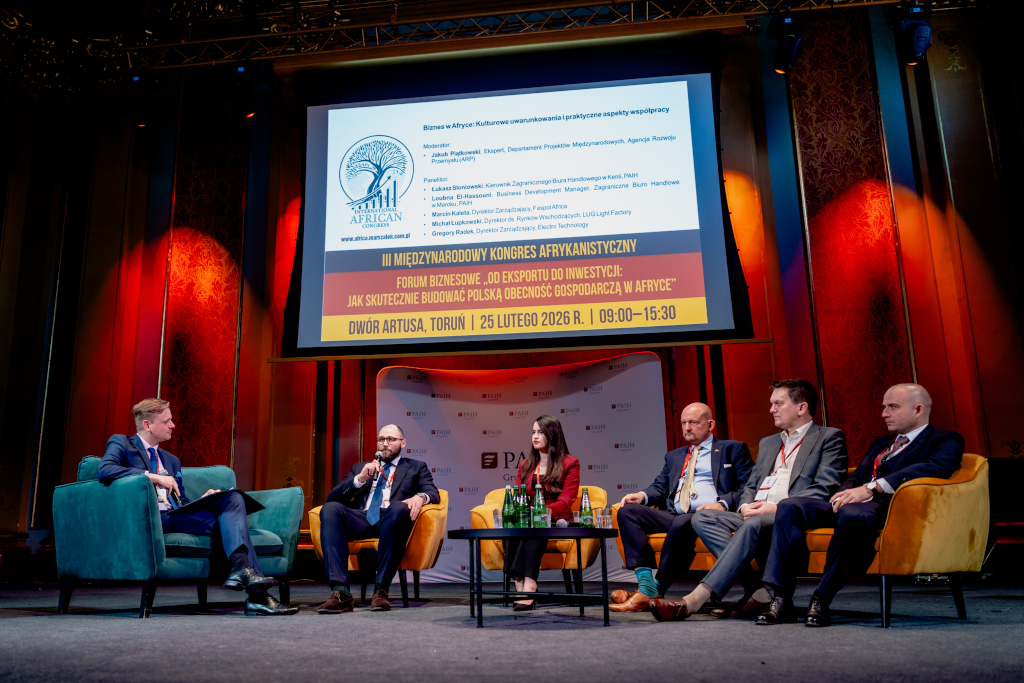
On 25 February in Toruń, representatives of Polish business and public administration discussed how to strengthen Poland’s economic presence on the African continent. Participants included representatives of the Polish Investment and Trade Agency (PAIH), the Industrial Development Agency (ARP), KUKE, Bank Gospodarstwa Krajowego (BGK), the Ministry of Development and Technology, as well as Polish companies expanding into Africa, such as PESA, FASPOL, LUG Light Factory, Asseco Data Systems and Electro Technology..
The key conclusion emerging from the panels was the need for Polish companies to adapt to African business culture. Those who have succeeded have done so through long-term relationship-building and patience. African entrepreneurs generally need to get to know the people with whom they are going to do business before entering into any transaction. Trust – often built over many years – carries greater weight than the quality or price of the product on offer. In this sense, African markets are a goldmine for the persistent.
An opportunity to build such relationships was provided by the banquet organised at the end of the Congress’s first day. In the historic Artus Court, entrepreneurs and public administration representatives had the chance to hold business talks with African diplomats, led by Mohamed Salah Eddine Belaid, Ambassador of Algeria – the honorary guest country of this year’s edition of the Congress. Guests also had the opportunity to sample Algerian culinary specialities.
What Does Polish Academia Think?
On 26 and 27 February, the strictly academic part of the Congress took place. It was attended by 342 scholars from Poland, Algeria, Tunisia, Morocco, Egypt, Nigeria, Ghana and other African countries. Ambassadors of more than a dozen African states and former Polish ambassadors to countries in Africa and the Middle East also participated, including Krzysztof Płomiński, Juliusz Gojło and Janusz Mrowiec, as well as the current Ambassador of Poland to Egypt, Mikołaj Murkociński. Rectors of Poland’s leading universities were also among the participants.
Over the course of two days, more than a dozen discussion panels were held in both in-person and online formats.
I personally had the opportunity to participate both in the business part of the Congress in person and in an online panel devoted to contemporary forms of neocolonialism. I presented my perspective and experiences from working in Algeria. Together with the other panellists, I concluded that the best path forward for African states is to move beyond the role of colonial victims, work through historical traumas, and assume responsibility for building modern institutions. Only in this way can they build resilience against the ambitions of global powers that benefit from a model based on importing raw materials from Africa and selling processed goods back to the continent.
It is also essential to foster African elites committed to industrial development and to advancing their countries in the interests of society as a whole, rather than merely serving a narrow ruling group. In some African states, such elites have already begun to emerge, as evidenced by the growing number of development strategies based on industrialisation and by projects aimed at creating the African Continental Free Trade Area.
Summary
The 3rd International African Congress in Toruń provided an opportunity for dialogue between communities that do not interact on a daily basis. Scholars from Poland and African countries were able to test their knowledge against the practical experience of business leaders and public administration representatives, including diplomats.
Poland’s future success on the African continent requires prior dialogue among multiple stakeholder groups. A significant advantage for Poland is that it did not participate in the colonisation of Africa and is itself a country that experienced partition and foreign domination. As a nation that has overcome post-colonial trauma, Poland can become a valuable partner for dynamically developing African states.
Maciej Pawłowski