
Conversation with Eldor Tulyakov – the Executive Director of the Development Strategy Centre in Tashkent
Uzbekistan is consistently pursuing an ambitious programme of state and economic modernisation. Digitalisation of public administration, the development of the private sector, the green transition and greater openness to foreign investors are positioning the country as one of the leading drivers of development in Central Asia. We discuss the priorities of the “Uzbekistan – 2030” Strategy, cooperation with the European Union and Poland, and Uzbekistan’s evolving role in the region with Eldor Tuliakov, Executive Director of the Development Strategy Centre of the Republic of Uzbekistan.
In recent years, Uzbekistan has implemented a number of significant reforms. Which of them do you consider the most transformative for the country’s development?
I would identify the digitalisation of public administration and public services as one of the most transformative reforms undertaken in Uzbekistan.
Only a few years ago, even a relatively simple administrative procedure often required citizens to visit multiple institutions, collect various documents and spend significant time waiting. Such a system contributed to excessive bureaucracy and created opportunities for abuse and discretionary decision-making.
Today, a wide range of public services can be accessed online – from submitting applications and making payments to tracking the progress of procedures. By the end of 2025, the Unified Interactive Public Services Portal provided approximately 800 electronic services, compared with only 60 in 2017. The platform had more than 12.5 million registered users, and over 39 million services were delivered through the portal during the first nine months of 2025 alone.
However, the significance of this reform goes far beyond technological advancement. Digital transformation has increased administrative transparency, reduced unnecessary direct interaction between citizens and public officials, and changed the very philosophy of governance. Public institutions are increasingly exchanging information with one another instead of repeatedly requesting the same documents from citizens.
In this sense, digitalisation represents a practical implementation of the principle that the state should serve its citizens.
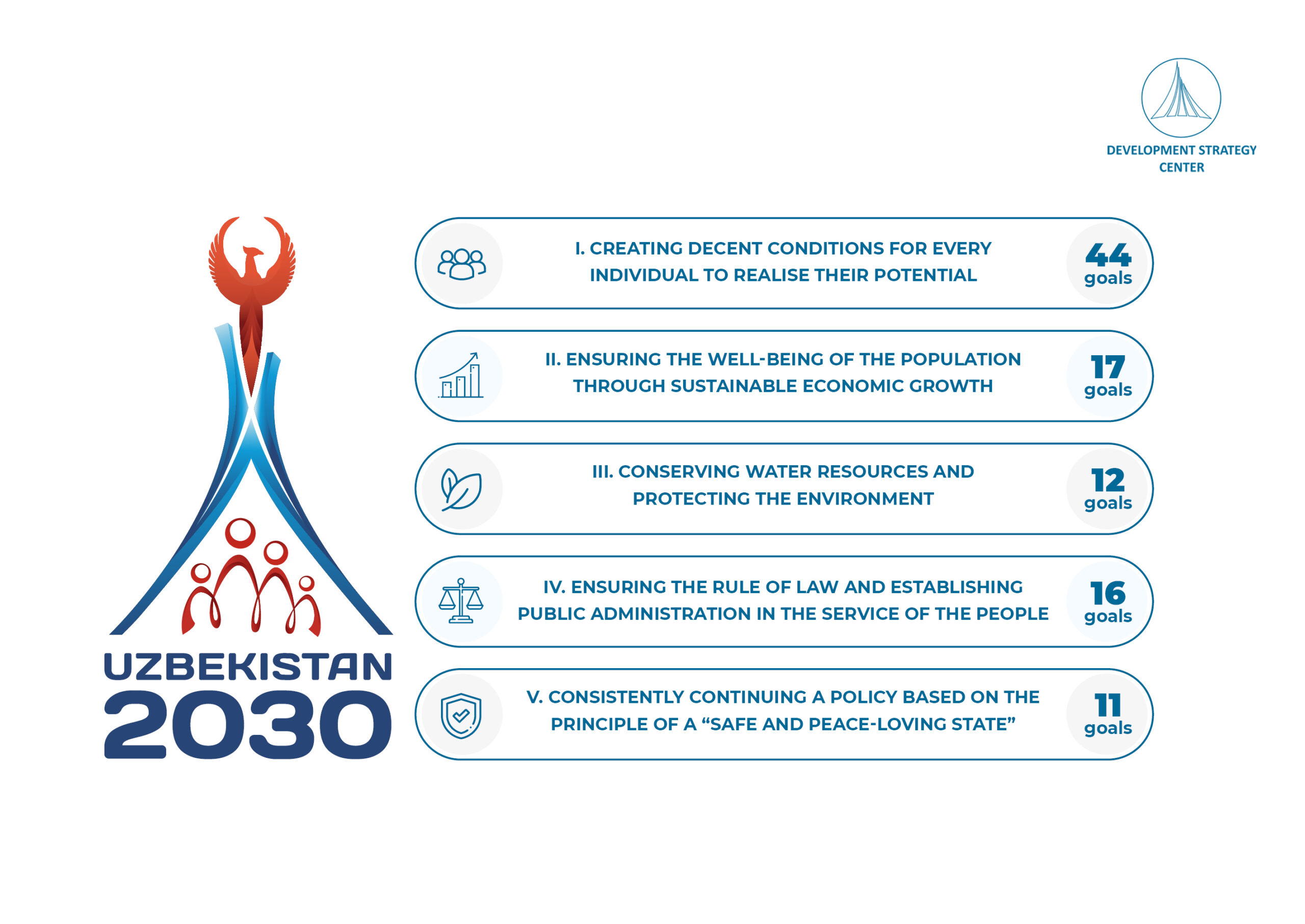
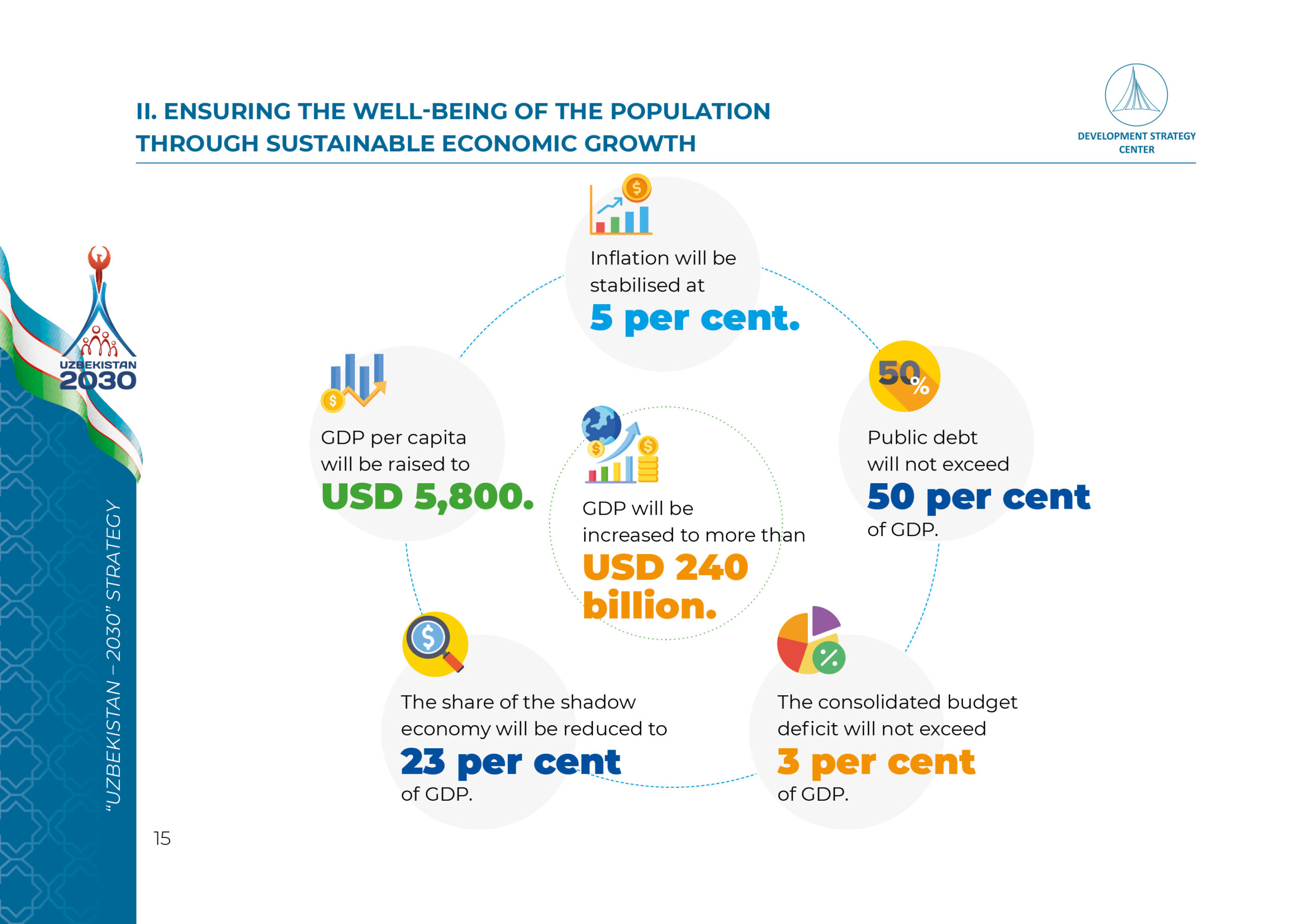
What economic objectives does the “Uzbekistan – 2030” Strategy set out?The “Uzbekistan – 2030” Strategy is designed to build a modern, competitive and diversified economy driven by private-sector development. By 2030, Uzbekistan aims to increase GDP to more than USD 240 billion and raise GDP per capita above USD 5,800, while maintaining macroeconomic stability and keeping inflation at approximately 5%.
The Strategy places strong emphasis on entrepreneurship development, privatisation, improving the governance of state-owned enterprises, and implementing more than 400 strategic technological and infrastructure projects with a total value of approximately USD 150 billion. At the same time, Uzbekistan is expanding high-value-added industries, increasing export capacity and investing in modern logistics networks and transport infrastructure.
Digital transformation, the development of services, agriculture, regional economies and the green transition are also among the Strategy’s key priorities. By 2030, renewable energy sources are expected to account for 54% of electricity generation.
The foundation of this transformation is investment in education, healthcare, human capital development and the creation of effective, accountable public institutions capable of supporting long-term economic growth.
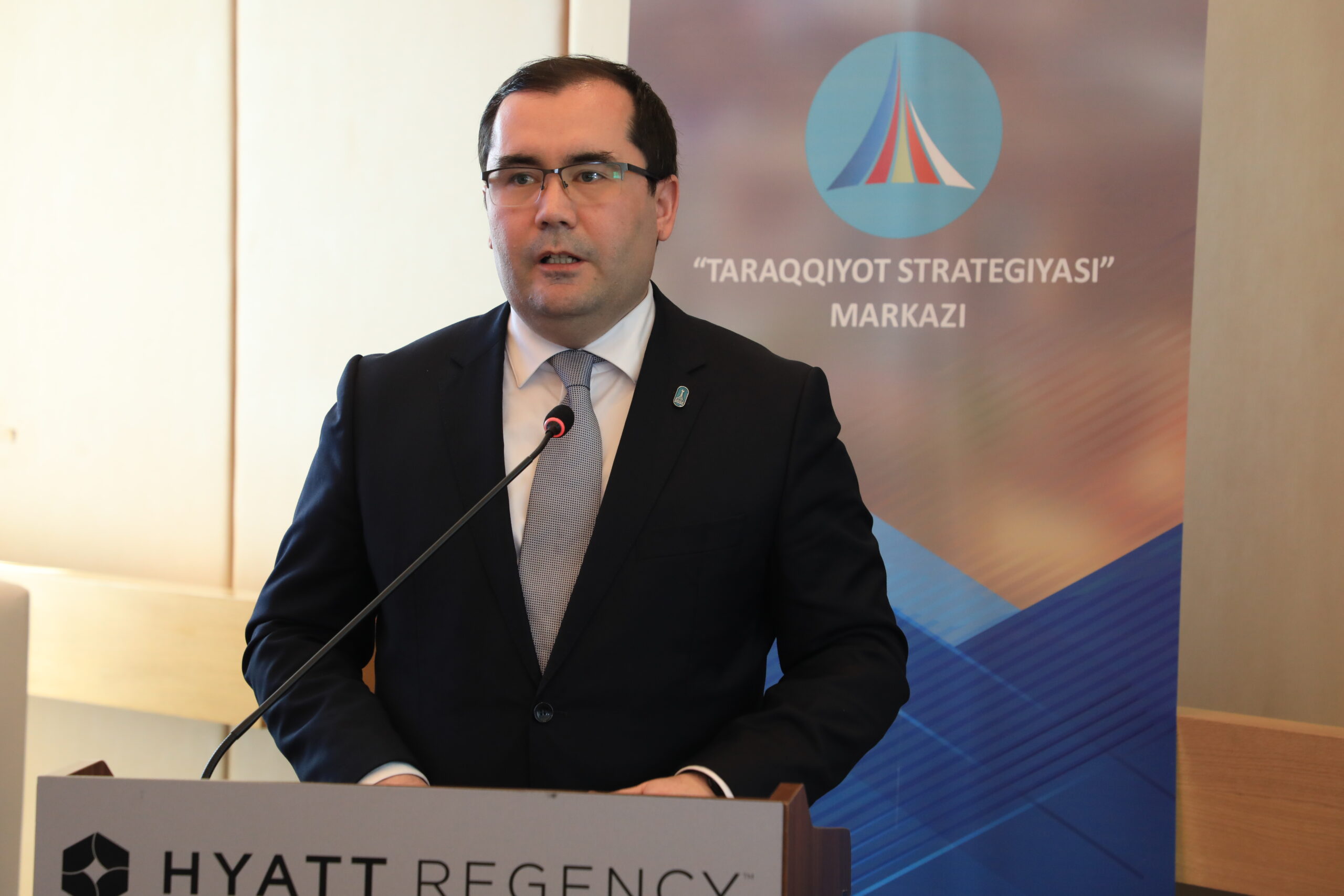
What role does the Development Strategy Centre play in designing and monitoring state reforms?
The Development Strategy Centre serves as a platform for dialogue between public administration, the expert community, civil society and the business sector. Together with the Agency for Strategic Development and Reforms, we monitor the implementation of the “Uzbekistan – 2030” Strategy, assessing progress and evaluating the effectiveness of measures undertaken by responsible institutions.
Our work goes beyond data analysis. We organise consultations with experts, entrepreneurs, non-governmental organisations and citizens in order to identify challenges that may not be fully reflected in statistical indicators alone. Based on these discussions and analytical findings, we develop recommendations aimed at improving reform implementation, strengthening coordination between institutions and removing legal and administrative barriers.
The Centre’s influence is based primarily on the quality of its analysis and the credibility of its recommendations. Our mission is to transform societal experience and research-based evidence into practical policy solutions that contribute to more effective public governance.
Which sectors of the economy currently offer the greatest opportunities for foreign investors?
The greatest opportunities lie in those areas where Uzbekistan’s development priorities intersect with the expertise, technologies and capital of international partners.
One of the most promising sectors is renewable energy. The “Uzbekistan – 2030” Strategy aims to increase renewable energy capacity to 25,000 MW and raise its share in electricity generation to 54%. This creates significant opportunities for investment in solar and wind energy, energy storage systems, grid modernisation and other green technologies.
Modern industry also offers substantial potential. Our objective is to develop high-value-added production, which is why we encourage foreign partners to participate in sectors such as electrical engineering, machinery, automotive manufacturing, chemicals, pharmaceuticals, textiles and food processing.
Agriculture represents another important area of opportunity, particularly in the introduction of modern production technologies, food processing solutions and logistics systems. Transport and logistics infrastructure are also strategic priorities, as improved connectivity can help Uzbekistan become a regional hub for trade and production, linking Central Asia with European and Asian markets.
Growing investment opportunities are also emerging in information technology, digital services, tourism, healthcare, education and modern financial services. Uzbekistan’s key advantages include a young population, a rapidly developing market and a strategic location at the heart of Central Asia.
How do you assess the prospects for economic and political cooperation between Uzbekistan and the European Union, including Poland?
Relations between Uzbekistan and the European Union are developing dynamically, although their economic potential has not yet been fully realised. A significant milestone was the signing in 2025 of the Enhanced Partnership and Cooperation Agreement, which establishes a modern framework for political dialogue and economic cooperation.
We share many common priorities, including the energy transition, digitalisation, infrastructure development, education, the rule of law and sustainable development. Uzbekistan offers a growing market and attractive investment opportunities, while European partners contribute advanced technologies, expertise and access to global markets.
Poland can play a particularly important role in this process. Its experience in economic modernisation, agriculture, food processing, industrial development and support for small and medium-sized enterprises is highly valuable for Uzbekistan. The next stage should focus on increasing the number of joint investment projects, expanding business, scientific and academic cooperation, and further reducing trade barriers.
How is Uzbekistan investing in its younger generation?
Investment in the younger generation is one of the foundations of Uzbekistan’s long-term development strategy. The knowledge, skills and entrepreneurial potential of young people will be among the key factors determining the future competitiveness of our economy.
The “Uzbekistan – 2030” Strategy focuses on improving the quality of education at all levels, expanding cooperation with foreign universities and increasing the presence of Uzbek higher education institutions in international rankings. At the same time, the government supports foreign language learning, provides opportunities for study at leading international universities and develops programmes aimed at strengthening professional qualifications.
We also place strong emphasis on entrepreneurship development. Our objectives include reducing youth unemployment, expanding vocational education and enabling young people to establish their own businesses through access to financing, mentoring and support programmes.
At the same time, we are developing an innovation ecosystem based on entrepreneurship incubators, technology parks, acceleration programmes and startup financing mechanisms. Our goal is to create an environment in which young people can transform knowledge and innovative ideas into modern enterprises capable of competing in international markets.
What role does Uzbekistan seek to play in Central Asia, and what are its strategic foreign policy objectives?
Central Asia remains the highest priority of Uzbekistan’s foreign policy. Our objective is to contribute to building a region based on peace, mutual trust, stability and shared prosperity. We believe that no country in the region can achieve sustainable development in isolation if common challenges related to security, transport connectivity, trade, water resources or energy remain unresolved.
Therefore, Uzbekistan consistently supports dialogue, good-neighbourly relations and practical regional cooperation. This approach has contributed to the expansion of trade, the implementation of joint investment projects and the development of new regional infrastructure initiatives.
We attach particular importance to the development of international transport corridors, including the Trans-Caspian and Trans-Afghan corridors, which can significantly strengthen connectivity between Central Asia, Europe and South Asia. A stable and economically developing Afghanistan also remains an important element of our regional vision, as its security and stability directly affect the entire region.
At the same time, Uzbekistan pursues an open, balanced and pragmatic foreign policy. We do not seek regional dominance; rather, we aim to be a reliable partner, a facilitator of dialogue and a country that supports solutions benefiting all states and peoples of Central Asia.
What do you consider your most important achievement, and what challenges does Uzbekistan still face?
My greatest professional satisfaction comes from contributing to a stronger connection between public policy, expert knowledge and citizens’ experiences. Throughout my work in public administration, parliament and, currently, at the Development Strategy Centre, I have always sought to ensure that reforms do not remain merely formal documents, but translate into tangible improvements in people’s lives.
One of the Centre’s most important achievements has been the creation of platforms for dialogue that bring together public institutions, the academic community, business representatives, civil society organisations and international partners. Such cooperation allows us to identify challenges more effectively and develop solutions based on evidence, analysis and the real needs of society.
At the same time, Uzbekistan continues to face important challenges. A key priority is ensuring the effective implementation of reforms at the regional and local levels, further strengthening public institutions and building a professional public administration based on accountability, competence and efficiency.
It is equally important to ensure that rapid economic development benefits all segments of society – particularly young people, women and communities across the regions. The ultimate goal is to establish a sustainable system in which public decisions are based on reliable analysis, institutions operate effectively and transparently, and citizens have a meaningful role in shaping the country’s future development.
Thank you for the conversation
Ada Krzewicka
Eldor Tulyakov – the Executive Director of the Development Strategy Centre in Tashkent, one of Uzbekistan’s leading policy research institutions (think tanks), dedicated to supporting the implementation of national development strategies and evaluating public sector reforms.