
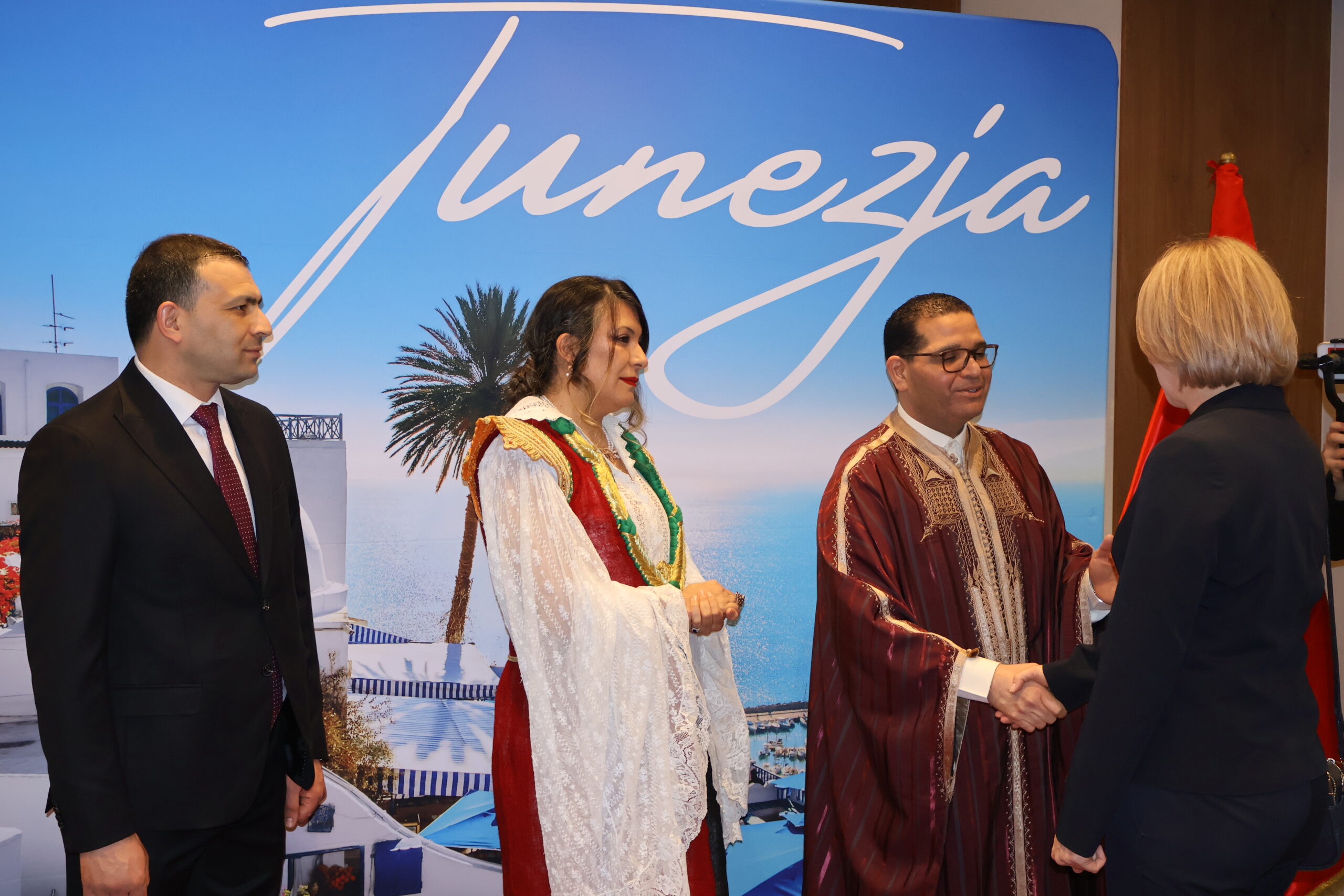
The official celebrations marking the 70th anniversary of the independence of the Republic of Tunisia brought together representatives of diplomacy, politics and culture in Warsaw on 25 March.
The event, organised by H.E. Ambassador Taoufik Chebbi, was not only an occasion for celebration but also a moment for reflection on the history, present and future of this North African country. In his speech, the Ambassador emphasised the importance of the struggle for freedom, paying tribute to national heroes: “Tunisia’s Independence Day is an opportunity to honour my compatriots who sacrificed their lives for the liberation of our homeland.” Tunisia gained independence in 1956, bringing an end to the period of French protectorate. From that moment, the country embarked on an intensive process of building a modern state which – as the Ambassador noted – successfully combined centuries-old heritage with ambitions for development.
The history of modern Tunisia is an example of consistent and far-reaching social reform. Already in the first years after independence, polygamy was abolished and women were granted extensive political rights – earlier than in many European countries. At the same time, the education and healthcare systems were significantly developed, becoming the foundation of social cohesion and economic growth. Thanks to these efforts, Tunisia earned a reputation as a stable, open and modern country.
H.E. Ambassador Chebbi also addressed contemporary challenges, recalling the transformations initiated by the 2010 revolution. Today, under the leadership of President Kaïs Saïed, the country is focused on building a more resilient economy and fostering sustainable long-term growth. “The goal of these efforts is to achieve stable, long-term growth, the benefits of which will be felt by all Tunisians,” the Ambassador emphasised. An important part of the speech concerned Polish–Tunisian relations, which have been developing dynamically for years. Mutual diplomatic visits, parliamentary cooperation and growing trade exchange demonstrate the increasing importance of this partnership. In 2025, trade turnover exceeded €425 million, and as many as 325,000 Polish tourists visited Tunisia, confirming its attractiveness as a travel destination. H.E. Taoufik Chebbi also highlighted the role of the Tunisian diaspora in Poland, emphasising the contribution of entrepreneurs to economic cooperation and the building of bridges between nations.
The Head of the Foreign Service, Henryka Mościcka-Dendys, also took the floor, stressing that Tunisia’s Independence Day is a symbol of courage, determination and the pursuit of freedom, while also reminding us of the responsibility associated with shaping the future of the state. She underlined the importance of values such as justice, equality and unity, which remain as relevant today as ever. She also pointed to Tunisia’s significant role as a partner of the European Union in the southern Mediterranean region, as well as the shared pursuit of stability and development based on close relations and common history.
The ceremony concluded with a cultural highlight that gave the event a distinctive and emotional dimension. A performance by Polish pianist Aleksandra Bobrowska and Tunisian tenor Hassen Doss became a symbolic dialogue between cultures, combining European musical sensitivity with Mediterranean expression. The artists took the audience on a subtle and emotionally rich journey, met with an enthusiastic reception and serving as a fitting finale to the evening.
The celebrations of the 70th anniversary of Tunisia’s independence in Warsaw were not only a diplomatic event, but also a reminder that history, reform and international cooperation can together shape a stable and promising future.
Ada Krzewicka