
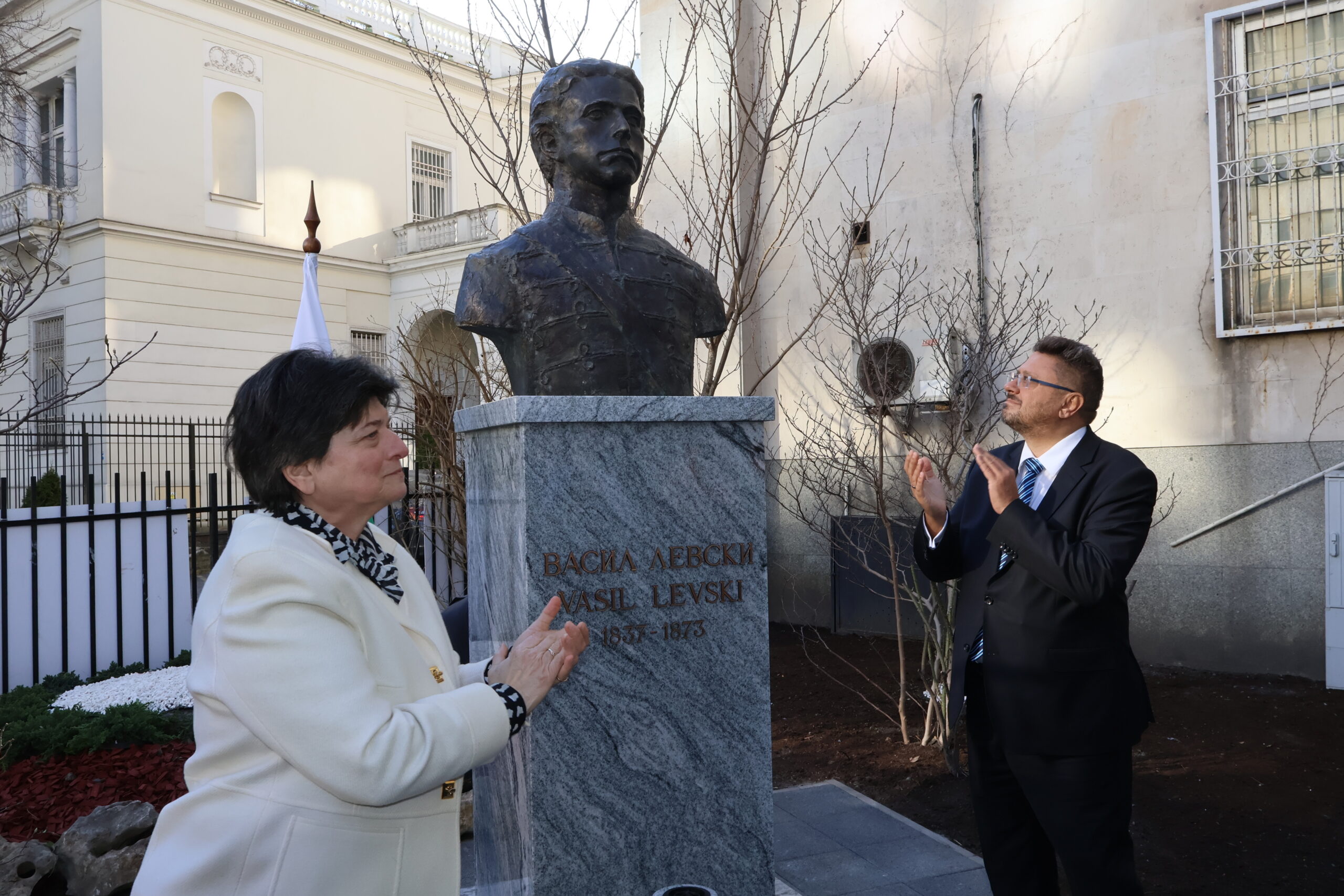
On 6 March, a new monument dedicated to Vasil Levski (1837–1873) – the pre-eminent Bulgarian national hero and visionary leader of the struggle for liberation – was formally inaugurated in Warsaw.
Situated within the gardens of the Embassy of the Republic of Bulgaria at Aleje Ujazdowskie 33/35, the monument is the collaborative work of sculptor Stanisław Korczew and architect Ceno Todorov. The ceremony convened distinguished state officials, members of the Bulgarian diaspora, and the diplomatic corps, highlighting the enduring, centuries-old bonds between Poland and Bulgaria.
Guests were received by Her Excellency Margarita Gancheva, Ambassador of Bulgaria to Poland. In her address, the Ambassador emphasised Levski’s enduring significance as a paragon of freedom, dignity, and national self-determination, noting that his Enlightenment ideals remain profoundly relevant today. She remarked that the presence of the monument in the Polish capital is not merely a tribute to a Bulgarian patriot, but a testament to the profound affinity between the two nations, rooted in a shared historical quest for sovereignty.
During the proceedings, Kiril Valchev, Director General of the Bulgarian News Agency (BTA), observed that Levski’s legacy renders every corner of the globe Bulgarian, asserting that the pursuit of liberty transcends all frontiers. These sentiments resonate powerfully with Polish history; indeed, many of Poland’s own pivotal struggles for independence unfolded concurrently with the Bulgarian national revivals.
The Warsaw monument forms part of the BTA’s “Bulgarian Places Around the World” initiative, designed to commemorate illustrious Bulgarians in locations of historical significance. To date, the programme has installed plaques for figures such as Aleko Konstantinov in Odesa, the Dalchev brothers in Thessaloniki, and Lyuben Karavelov in Belgrade.
The unveiling of Levski’s likeness in Warsaw serves as a symbolic bridge, reflecting the shared values of courage and brotherhood. As Levski famously exhorted: We extend our hand to everyone who wishes to join us in shedding blood for the life and freedom of mankind. In this spirit, the monument stands as a reminder of the collective dreams of liberty that shaped the histories of both nations and continue to inspire future generations.
Vasil Levski: The “Apostle of Freedom”
Vasil Levski, born Vasil Ivanov Kunchev, was a revolutionary strategist of unparalleled influence. Though he entered the monastic life in his youth under the name Ignatius, he abandoned the cloister in 1861 to dedicate himself to the patriotic cause. By 1862, he had joined the Bulgarian Legion in Serbia, organised by Georgi Rakovski, where he adopted the pseudonym “Levski” (Lion-like). A veteran of numerous engagements against the Ottoman Empire, Levski spent the late 1860s in Bucharest refining his revolutionary philosophy. He envisioned a “holy and sacred republic” built upon the democratic principles of the Declaration of the Rights of Man and of the Citizen.
Between 1869 and 1871, Levski established the Internal Revolutionary Organisation – a sophisticated network of clandestine committees tasked with procurement, military training, and resistance. In 1872, he merged his network with the Bulgarian Revolutionary Central Committee. Following his return to Bulgaria, he was apprehended by Ottoman authorities on 27 December 1872. Levski was subsequently sentenced to death and executed by hanging on 18 February 1873 in Sofia.
While he did not live to see the end of the struggle, his tactical genius and the infrastructure he built were instrumental to the April Uprising of 1876. This eventual surge of resistance paved the way for the Russo-Turkish War (1877–1878) and Bulgaria’s ultimate liberation after five centuries of Ottoman rule.
Anna Wysocka