
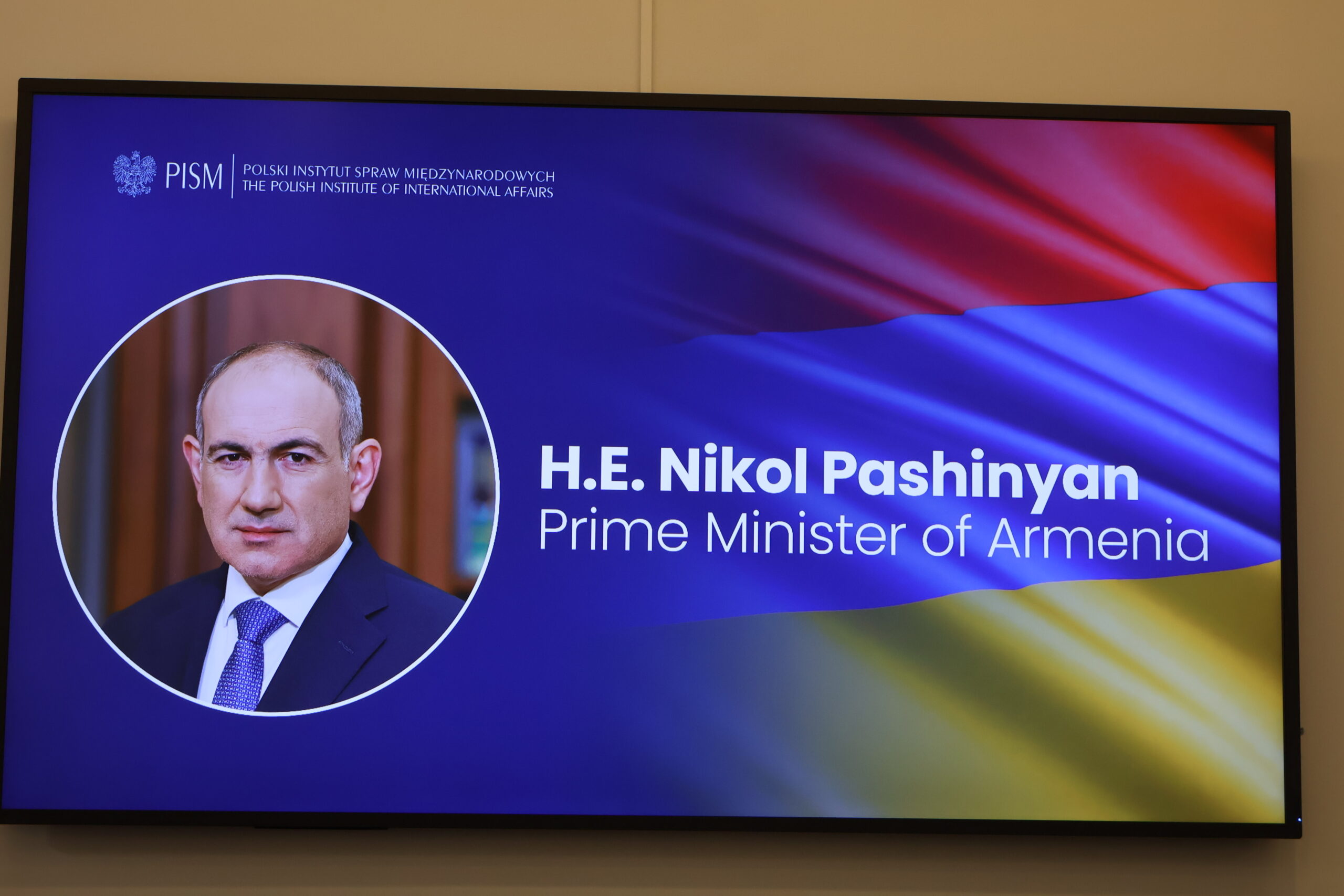
On 25 February, a lecture by the Prime Minister of Armenia, Nikol Pashinyan, entitled ‘Armenia and the New Architecture of Peace in the South Caucasus’, was delivered at the Polish Institute of International Affairs during his official visit to Poland.
The event formed part of the Prime Minister’s visit to Warsaw, during which he held meetings with representatives of the Polish government. These talks focused on strengthening political, economic and security cooperation, highlighting both the European and bilateral dimensions of the dialogue. The lecture itself centred on key shifts in Armenia’s foreign policy, as well as on a new phase in the peace process in the South Caucasus.
A central theme of the Prime Minister’s address was the evolution of Armenia’s foreign policy in response to a changing security environment. Pashinyan emphasised that, for more than two years, Armenia has been pursuing a significant strategic shift aimed at balancing its traditional relations with Russia while intensifying cooperation with the European Union and the United States. He made it clear that Armenia does not intend to abandon its existing partnerships, but rather seeks to develop a more balanced and autonomous foreign policy. In this context, he underscored the importance of cooperation with the European Union in areas such as democratic reform, security enhancement and institutional resilience – all of which are intended to support Armenia’s transformation and strengthen its position within the broader Euro-Atlantic democratic space.
The Prime Minister stressed that, since 2022, Armenia has received tangible support from the European Union and Poland, notably through the deployment of a European civilian monitoring mission. He described the EU as Armenia’s most important and most reliable partner in strengthening democracy and implementing reforms. He also recalled that the Armenian parliament had adopted legislation initiating the country’s accession process to the EU, which is expected to provide further impetus for reform. Armenia, he noted, aims to deepen cooperation with the EU and its member states across a wide range of sectors, including the economy, governance and defence. He also expressed hope for increased EU involvement in the development of regional transport connections, as well as for greater investment from both the Union and its member states. In addition, he referred to the early stages of cooperation in the field of security and Armenia’s participation in the European Peace Facility.
A significant part of the speech was devoted to the concept of a new ‘architecture of peace’ in the South Caucasus. Pashinyan observed that, after more than three decades of tension and conflict – particularly over Nagorno-Karabakh – Armenia and Azerbaijan have adopted an important declaration concerning a future peace settlement, supported by the United States. Although the process has not yet resulted in a comprehensive peace treaty, he emphasised that it represents a meaningful geopolitical shift in the region. He further noted that 2025 was the first year since Armenia’s independence in which no casualties were recorded along the Armenian–Azerbaijani border – a development he described as a genuine, albeit still fragile, de-escalation. At the same time, he stressed that ‘peace is under construction’ and must be supported by durable institutional mechanisms, rather than relying solely on the temporary absence of hostilities.
In the latter part of his address, the Prime Minister turned to infrastructure initiatives that could underpin regional stability and economic development. In this context, he referred to a project described as the ‘Trump Route for International Peace and Prosperity’, aimed at developing transport infrastructure that could position Armenia as a key corridor linking the European Union with Central Asia. The initiative includes, among other elements, railway modernisation and the expansion of road networks, which – according to the Prime Minister – could stimulate trade, logistics and broader economic cooperation across the region. He also mentioned progress in the normalisation of relations with Turkey, as well as the role of neighbouring countries such as Georgia and Iran, which, to varying degrees, support efforts to stabilise the South Caucasus.
The Prime Minister also highlighted the importance of domestic factors in shaping Armenia’s future foreign and security policy. He noted that the country’s international trajectory will depend to a large extent on progress in democratic reforms and on the internal political situation, including the outcome of the parliamentary elections scheduled for June 2026. Challenges related to democratisation and the strengthening of the rule of law – though considerable – are, in his view, essential for Armenia’s effective pursuit of its political and international objectives.
Following the lecture, the Prime Minister took part in a question-and-answer session with diplomats, experts and representatives of analytical communities gathered at the Polish Institute of International Affairs. The discussion addressed issues such as the future of economic cooperation in the region, regional security and mechanisms to support the stabilisation of relations between Armenia and its neighbours. The meeting offered a valuable opportunity for broader reflection on Armenia’s role in the evolving geopolitical landscape of the South Caucasus, as well as on the prospects for building lasting peace in the region.
Anna Wysocka