
The official celebrations of the National Day and Armed Forces Day of the Hellenic Republic, held on 30 March 2026 at the Witold Lutosławski Concert Studio of Polish Radio in Warsaw, were not only an occasion to commemorate history, but also an opportunity to reflect on the present and the future of Europe.
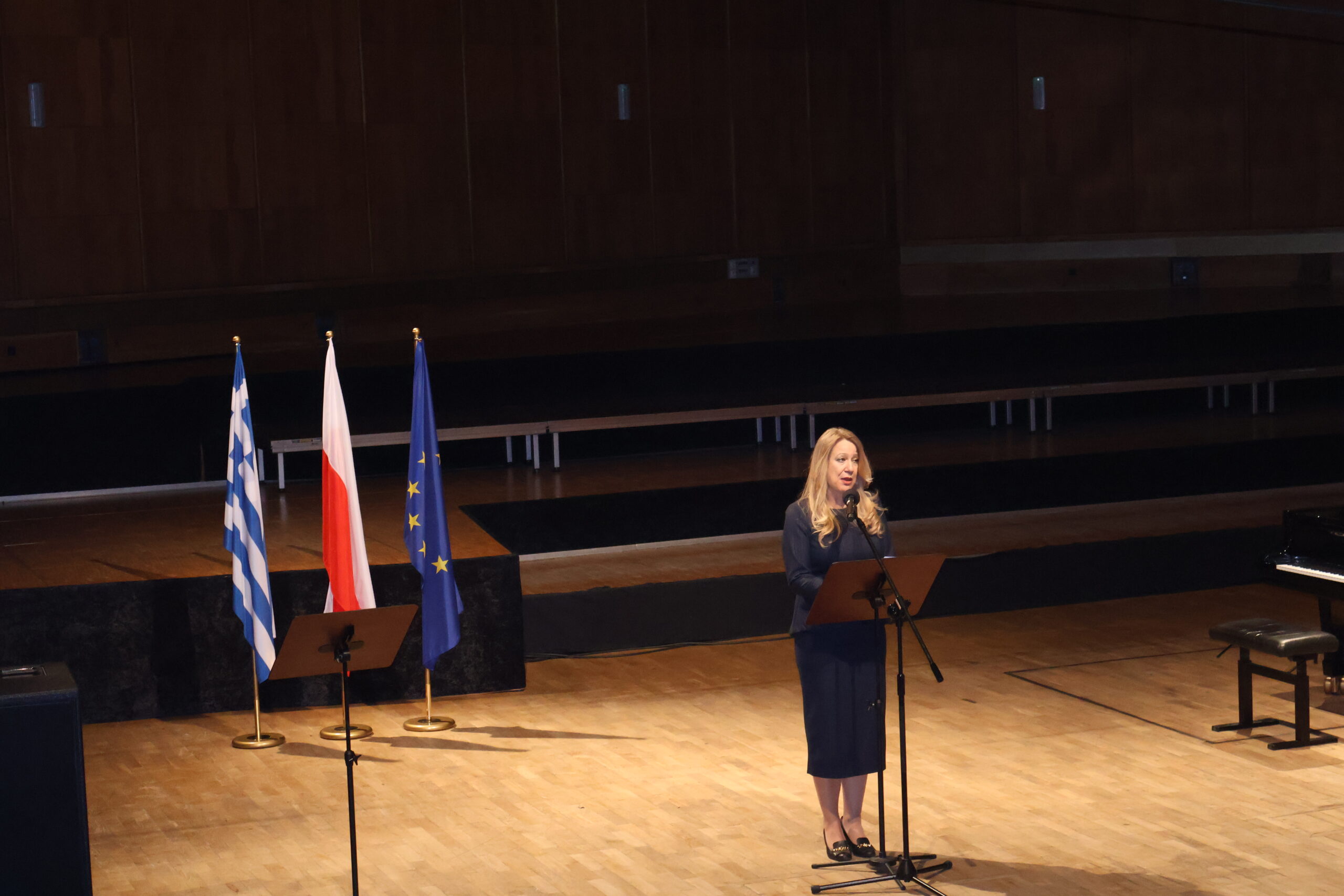
The centrepiece of the ceremony was the speech delivered by H.E. Niki Kamba, Ambassador of Greece to Poland, which served both as a tribute to the past and as a thoughtful response to contemporary challenges. Particular attention in her address was devoted to the anniversary of the Greek War of Independence of 1821, as well as the forthcoming bicentenary of the heroic Exodus from Messolonghi.
As H.E. Niki Kamba, Ambassador of Greece to Poland, emphasised:
– 25 March is a symbol of national pride and resilience that resonates far beyond the borders of Greece. The Greek Revolution of 1821 is not merely a historical milestone, but also a living testament to the universal struggle for fundamental values such as dignity, self-determination, democracy, human rights and freedom. These shared principles unite Greece and Poland, as both nations understand the price of freedom and draw strength from their history in building a secure future.
These remarks clearly demonstrate that history – although rooted in the past – continues to serve as a living foundation of modern national identity and international solidarity.
The Ambassador also drew attention to the current geopolitical context, underlining the importance of unity and responsibility within the international community in the face of ongoing conflicts. In this regard, she noted that the values for which the heroes of Messolonghi fought remain profoundly relevant today.
– Across our region and beyond, the principles for which the people of Messolonghi fought – freedom, sovereignty and human dignity – are once again being tested. The war in Ukraine has reminded us that peace and stability can never be taken for granted, and that we must work together to safeguard them.
The speech also presented a clear vision of contemporary Greece as a dynamic and steadily developing country – economically stable and actively engaged on the international stage. Emphasis was placed on its role as a key partner within the European Union and NATO, as well as its growing importance in areas such as innovation, digital transformation and security.
An important element of the address was also a reflection on Greek–Polish relations. H.E. Niki Kamba highlighted their steady development – not only in political and economic terms, but also in cultural exchange. Particular significance was attached to the recent repatriation of Greek-Jewish artefacts from the Second World War, which stood as a symbol of exemplary cooperation between the two countries.
The Ambassador also referred to tourism and people-to-people contacts, which, as she noted, remain one of the most important pillars of mutual understanding and relationship-building between societies.
The ceremony concluded with a concert by outstanding Greek artists – the pianist Kateryna Drosaki and the soprano Danae Eleni – whose performance underscored the role of culture as a universal language capable of uniting nations. The programme featured works by eminent Greek composers, including Yannis Markopoulos, Ioannis Constantinidis, Manolis Kalomiris, Solon Michaelides, Mikis Theodorakis and Manos Hadjidakis, among others whose achievements form an integral part of Greece’s musical heritage.
The event brought together representatives of diplomacy, culture and public life, further highlighting the strong ties between Greece and Poland.
The ceremony in Warsaw demonstrated that relations between Greece and Poland are founded not only on shared history and values, but also on genuine partnership and a common vision for the future. It was both a celebration of memory and a clear indication that cooperation between the two countries remains vibrant, dynamic and full of promise.