
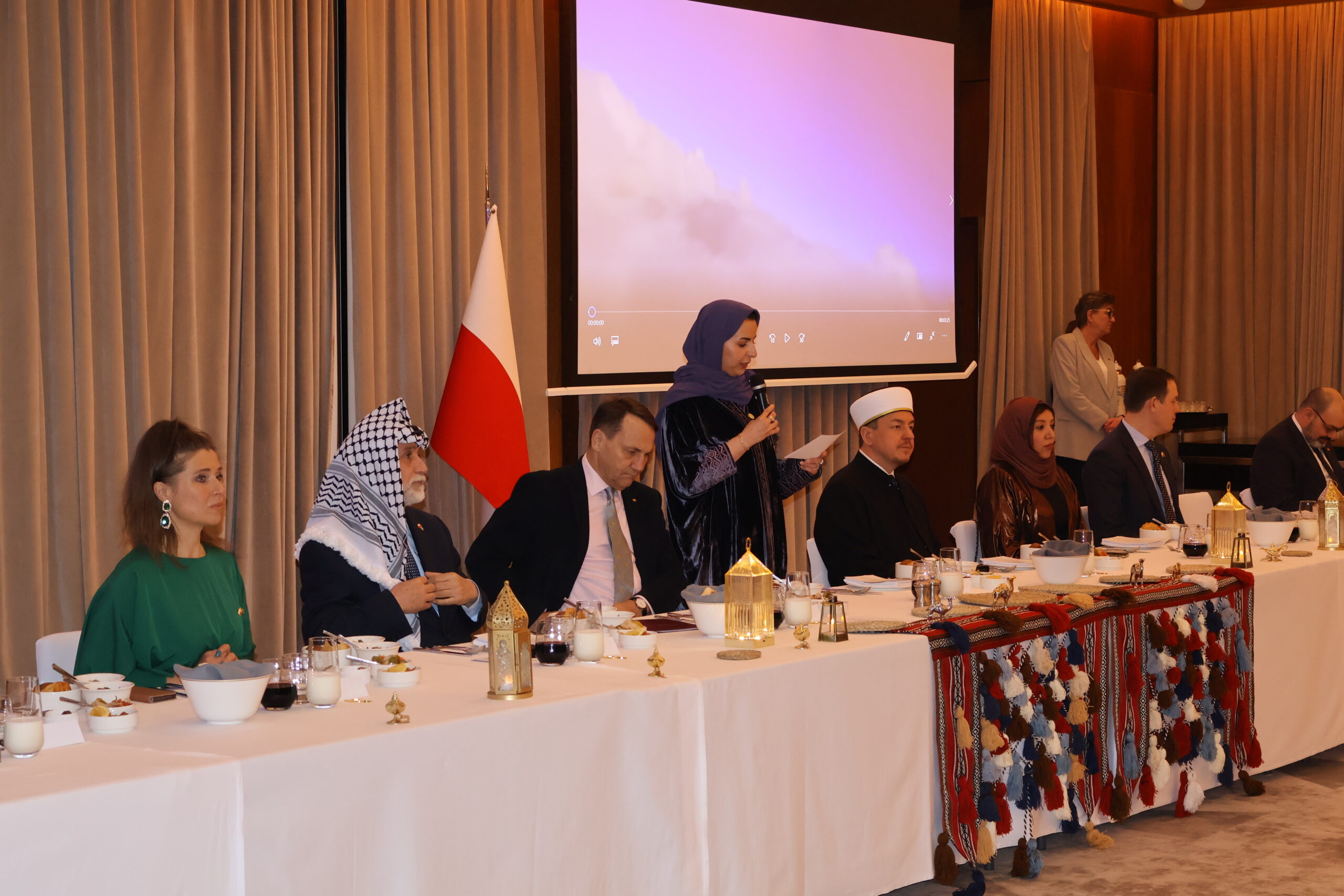
On 25 February, a festive iftar dinner was held in the elegant surroundings of Raffles Europejski Warsaw. Iftar is the first meal eaten after sunset during the holy month of Ramadan.
Iftar is a special moment in Ramadan – a month of fasting, prayer and spiritual reflection observed by Muslims around the world. The fast begins at dawn with the suhur meal and lasts until sunset. During this time, the faithful abstain from food, drink and other worldly pleasures. The evening meal, preceded by the Maghrib prayer, has a distinctly communal character – it is often shared with family, friends and invited guests. In Muslim tradition, sharing a meal symbolises solidarity, hospitality and unity.
The host of this year’s event was Her Excellency Enass A. Alshahwan, Ambassador of the Kingdom of Saudi Arabia to Poland, while the guest of honour was Poland’s Minister of Foreign Affairs, Radosław Sikorski.
Her Excellency the Ambassador welcomed the guests with the following words:
– May the blessings and mercy of God be upon you. As Ambassador of the Kingdom of Saudi Arabia – the birthplace of Islam, the Custodian of the Two Holy Mosques, and the host country of the Organisation of Islamic Cooperation – it is my great honour and privilege to welcome you all to this special gathering during the holy month of Ramadan. I would like to extend my sincere gratitude to His Excellency the Minister of Foreign Affairs for honouring us with his presence, as well as to all the distinguished guests from Parliament and the various ministries. It is a true pleasure to have you all with us this evening. Ramadan is a time for reflection and compassion. As we break our fast, we are reminded of the deeper meaning of this sacred month – peace, empathy and generosity towards those in need. Our gathering today is a sincere expression of the values of tolerance and coexistence, values that our world needs now more than ever. It also serves as a reminder that our cultural and religious diversity is a source of enrichment, not division. Once again, welcome to this Ramadan iftar. May this evening be filled with warmth, meaningful conversation and the spirit of togetherness that defines this blessed month. Ramadan Mubarak.
During the gala dinner, Ambassador Enass Alshahwan also underscored the immense importance of intercultural dialogue. She noted that Ramadan is a time of spiritual renewal, deep reflection and mutual support, one that brings communities together regardless of their differences. She added that organising the iftar in Warsaw was an expression of openness and a desire to share the richness of Saudi tradition with Polish partners, thereby fostering understanding and friendship between nations.
When taking the floor, Minister Sikorski expressed his delight at having the opportunity to participate in the iftar, emphasising the value of this Ramadan tradition and thanking Ambassador Enass Alshahwan for her hospitality. He observed that we live in times of rapid change, which bring new threats, and that conflicts in distant regions also resonate in our daily lives. At the same time, he stressed that, despite these difficulties, the world remains our shared space – one in which we must cooperate and show one another respect.
The Minister also drew attention to the convergence of the Muslim holy month of Ramadan and the Christian season of Lent as an opportunity to reflect on the value of dialogue, mutual understanding and spiritual renewal. Quoting the words of Ibn Hazm, he noted that the pursuit of peace requires attentiveness and effort, and emphasised that this truth remains just as relevant today.
Referring to the current challenges facing the Arab world, the Minister pointed to the conflicts and crises in Israel and Palestine, Iran, Sudan, Yemen and Syria as evidence of the fragility of peace and the importance of taking responsibility for preserving it. He emphasised that Poland supports international stabilisation efforts, including through humanitarian aid, and continues to cultivate multifaceted relations with Arab and Muslim countries in the fields of politics, trade, education and culture.
In conclusion, he highlighted Poland’s centuries-old tradition of peaceful coexistence among different cultures and religions, expressing the hope that it would serve as an example of openness and tolerance for future generations. He wished everyone a Ramadan filled with joy, reflection and a sense of community.
The event was attended by ambassadors from Arab states, invited heads of diplomatic missions accredited to Poland, and representatives of opinion-forming circles. The meeting had not only a religious and cultural dimension, but also a diplomatic one – fitting naturally into the tradition of building relations through dialogue and personal contact. Sharing a meal became a symbol of solidarity, hospitality and unity, bringing people together in an atmosphere of mutual respect and warmth.
Ada Krzewicka