
Cooperation yields the advantage – this was the recurring motif in Foreign Minister Radosław Sikorski’s policy statement. In his view, such collaboration is indispensable both within the European Union and in relations with global partners if we are to meet the formidable challenges of the modern world.
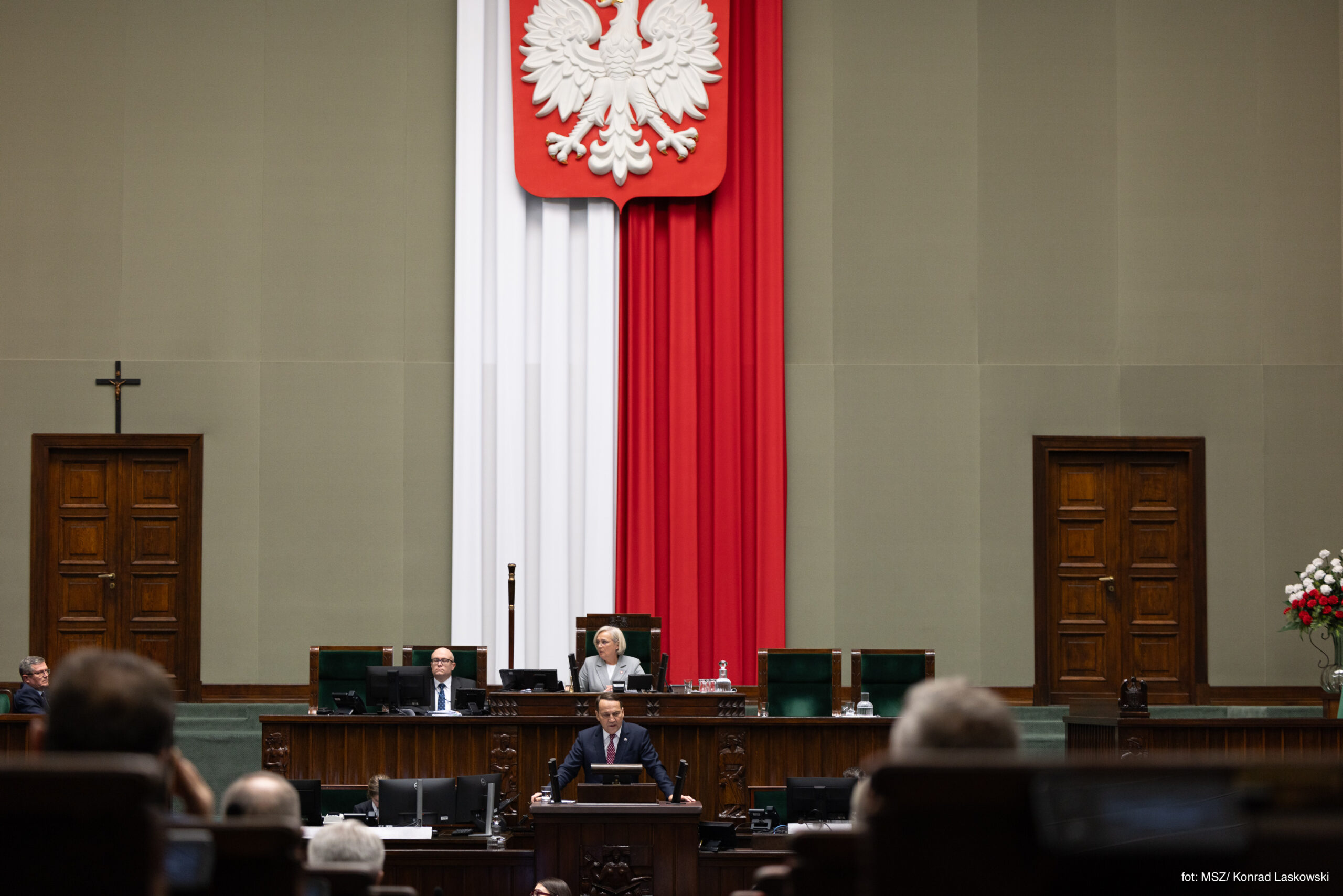
In an extensive, eighty-minute address delivered to the Sejm on 26 February, the head of Polish diplomacy outlined the nation’s strategic priorities, primarily within the European arena and transatlantic relations. He also devoted significant attention to Poland’s burgeoning international stature, bolstered by its position as the world’s twentieth-largest economy.
Poland Stands for the UN Charter, Against the Law of the Jungle
The Minister painted a sobering portrait of the contemporary global landscape, where concerns arise not only from the war in Ukraine and the Kremlin’s attendant disinformation campaign but also from other unsettling trends. The international order is being shaken to its foundations. We have witnessed a pivot toward power politics at the expense of norms. We see attempts to return to a ‘Concert of Powers’ – a world where the largest states carve out spheres of influence and claim exceptional, even territorial, rights, Sikorski remarked. He stated unequivocally that Polish foreign policy rejects the doctrine of ‘might makes right.’
We remain steadfast in our commitment to an international order based on the United Nations Charter – specifically on respect for sovereignty, territorial integrity, and the prohibition of the use of force, Sikorski declared. He acknowledged that while international law is not always upheld, it must remain the ultimate reference point; for where divine and human laws vanish, the ‘law of the jungle’ takes hold.
The exposé was delivered just days before the outbreak of hostilities in Iran, meaning the Minister could not yet address the dramatic events in the Persian Gulf. However, he pointed clearly to the threat posed by Russia and emphasised the absolute necessity of supporting a fighting Ukraine. In doing so, he invoked the words of the eminent Polish émigré intellectual Jerzy Giedroyc from the 1990s: We must maintain the independence of Ukraine, Lithuania, and Belarus at all costs, for it is in our vital national interest.
According to the Minister, security is the paramount priority. To ensure it for Poland, one must stand firmly on two legs: the European and the transatlantic, Sikorski stated. He devoted further extensive passages of his address to relations with Europe and the United States.
Better Within Europe, Despite the Frictions
The Polish government regards presence in – and the active shaping of – the European Union as a matter of raison d’état. While consensus is often elusive, Sikorski noted that cooperation yields the advantage, quoting the Bulgarian philosopher Ivan Krastev: We have collective dreams, but our fears remain national.
The Minister addressed the rising anti-EU sentiment in Poland and other Member States. Would Polexit, or indeed the dissolution of the Union, be the appropriate response to the European Union’s shortcomings? It would be just as appropriate as scrapping a car simply because the suspension requires servicing, Sikorski said. He cited public opinion polls from Great Britain, according to which 69% of British farmers believe they have personally lost out as a result.
Radosław Sikorski noted the voices appearing in Poland that are hostile to the Union and simultaneously suggest that it primarily serves German interests. He admitted that while we have contentious issues with our western neighbour, there are more common interests. Today, Poland ranks fourth on the list of the largest suppliers of goods to Germany – behind China, the USA, and the Netherlands, but ahead of France or Italy. We are also the fourth-largest recipient of German exports, larger than China, the Minister noted. If we were alone, our voice would be weaker. By acting together as the Union, we are able to better look after our interests (…). Because cooperation yields the advantage.
A Difficult but Essential Partnership with the US
Speaking of relations with the United States, the Minister firmly declared that Poland would be their ally. He stated that the USA is our ally regardless of who occupies the White House or who holds the majority in Congress. But it is not Europe that puts forward territorial claims, imposes arbitrary tariffs, or interferes in the partisan rivalry on the other side of the Atlantic, the Minister noted. He also mentioned that Poland has provided military support to the United States. Alongside American soldiers, many Europeans, including Poles, fought in Afghanistan, Sikorski recalled, noting that this support was paid for with the loss of lives.
However, this cooperation is not only about the sacrifice of soldiers’ blood. It also has a financial value. Under 128 contracts, we are spending 63 billion dollars on the purchase of American weapons and military technologies. In doing so, we are creating jobs in fifteen US states – from California, Texas, and Florida, to Illinois, Ohio, and New York, Minister Sikorski remarked.
The speech also included a bitter historical note – the Minister recalled the effective handing over of Eastern European countries into the Soviet sphere of influence at the Yalta Conference in 1945. This was the price for Soviet assistance in defeating Japan. Sikorski mentioned that a few days earlier, the USA, like China, had abstained from voting at the UN General Assembly on the matter of the inviolability of Ukraine’s borders. If Japan from 1945 were replaced by today’s China, can we be certain that the interest of the United States will be identical to Poland’s? We have been and will remain a loyal ally of America. But we cannot be suckers, Sikorski stated.
A Strong Poland Built on a Strong Economy
Minister Sikorski’s exposé also addressed economic aspects. Emphasising that Poland is now among the 20 most developed countries in the world, the Minister declared active cooperation with other G20 members.
However, significant risks also exist in economic matters, arising, for instance, from the dependence of European countries on Chinese electronics, crude oil, and many other natural resources. In the case of certain minerals, imports account for as much as 98% of Europe’s demand. We must address this by building coalitions with the Americans, European partners, and partners from other continents, the Minister said, noting once again that in this aspect, too, cooperation yields the advantage.
Towards the end of his address, Radosław Sikorski mentioned the matter of ambassadorial appointments. He thanked former President Andrzej Duda for signing 24 such appointments during his final year in office. He also appealed to the current President, Karol Nawrocki, to approve the 49 candidates for ambassadorial posts.
Paweł Rochowicz