
On 3 March, a special ceremony took place in the Great Hall of the Royal Castle in Warsaw, bringing together music, diplomacy and the spirit of friendship between nations.
On the occasion of Romanian–Polish Solidarity Day – observed annually on this date – the Embassy of Romania in the Republic of Poland, together with the Romanian Cultural Institute in Warsaw, organised an evening rich in emotion, cultural depth and symbolic significance. The event was held under the honorary patronage of the Ministers of Foreign Affairs of Romania and Poland.
The guests were welcomed by H.E. the Ambassador of Romania to Poland, Cosmin Onisii, who opened the ceremony with the following words:
– This is, in fact, the third anniversary of Solidarity Day, established in April 2023 by concurrent acts adopted by the parliaments of our two countries. However, it is the first time that we have had the privilege of marking it in the presence of the Ministers of Foreign Affairs of Romania and the Republic of Poland. We are extremely grateful for that.
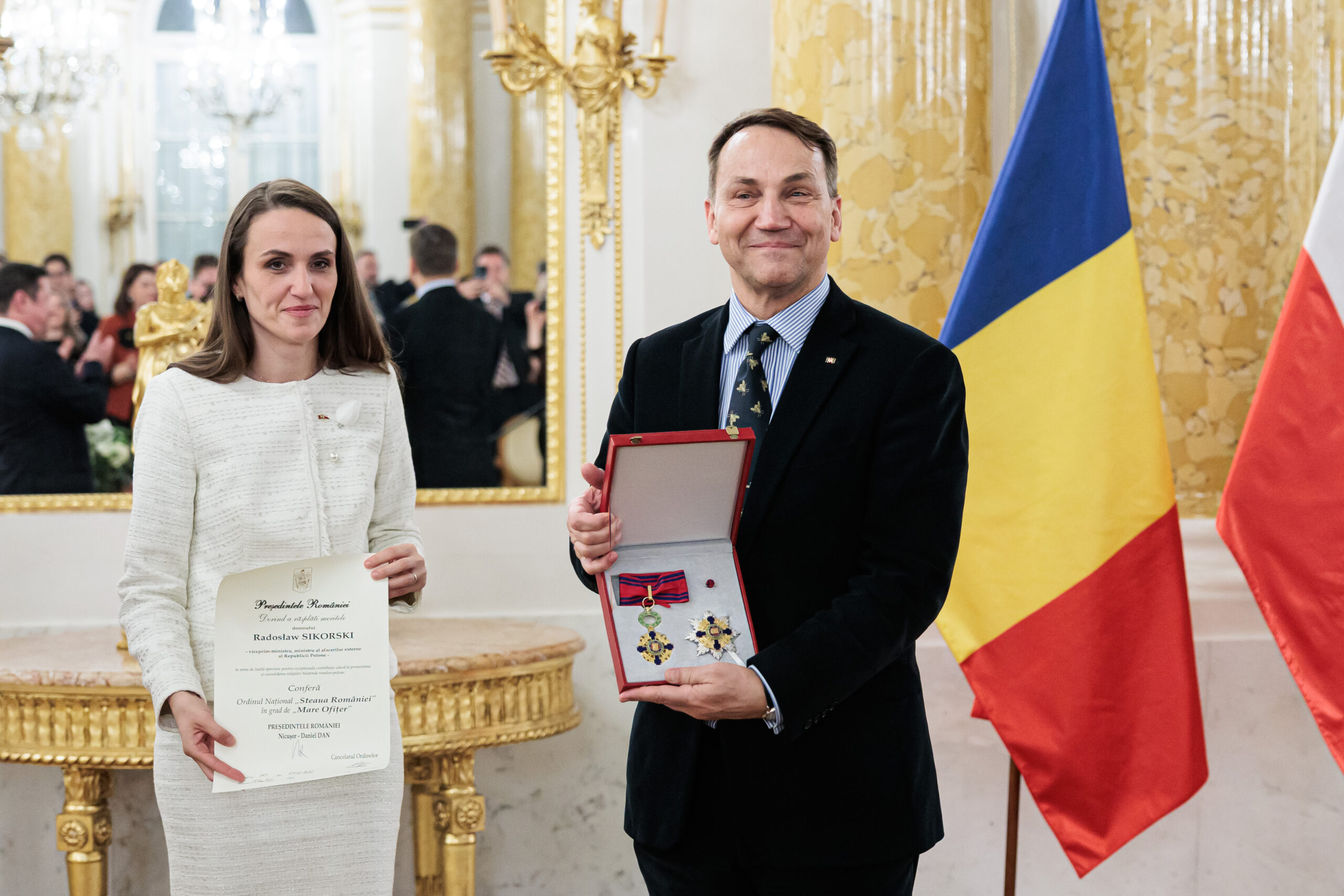
As part of the evening’s celebrations, Minister Radosław Sikorski was awarded Romania’s highest civilian distinction – the National Order of the “Star of Romania” in the rank of Grand Officer – in recognition of his contribution to the development of the Strategic Partnership between the two countries and to strengthening Polish–Romanian relations.
The decoration was presented in person by Oana-Silvia Țoiu, Romania’s Minister of Foreign Affairs, who in her address emphasised Minister Sikorski’s long-standing commitment to promoting shared values and advancing bilateral initiatives. The laudation delivered during the ceremony highlighted his role as a steadfast friend of Romania and a statesman who consistently supports political and cultural dialogue across Central and Eastern Europe.
In his remarks, the decorated minister expressed his gratitude for the honour and underscored the enduring strength of the Polish–Romanian partnership:
– I am honoured to mark this special day together with the President of Romania, and equally honoured to have been awarded the National Order of the Republic of Romania. I see it as a symbol not only of our personal ties, but above all of the friendship between our nations. After 1918, as Europe was recovering from war, Poland and Romania found themselves in a similar geopolitical and social landscape. This convergence laid the foundations for a partnership rooted not only in shared interests, but also in foresight and trust. That partnership has withstood the historical turbulence through which both our countries have passed. For over a century, we have stood side by side – through shifting borders, changing alliances and the many trials imposed by history. Our shared experience demonstrates that Poland and Romania are nations bound by a profound sense of harmony.
The evening opened with a chamber concert that became a true journey through the musical heritage of Central and Eastern Europe. The Arcadia Quartet took to the stage – an ensemble acclaimed at international competitions, including the Wigmore Hall International Chamber Music Competition, and renowned for its precision, depth of interpretation and technical excellence.
The programme featured three contrasting works that together captured the essence of 20th-century European music. The concert began with the delicate and lyrically rich Aubade (1899) by George Enescu – a piece that transports the listener into a world of harmony and poetic reflection. This was followed by String Quartet No. 2 (1940) by Mieczysław Weinberg – a composition of striking emotional intensity and refined neoclassical structure, reflecting the turbulence of its time. The evening concluded with String Quartet No. 4 (1928) by Béla Bartók – a work brimming with modern energy, rhythmic vitality and architectural clarity, widely regarded as one of the masterpieces of 20th-century chamber music.
The Arcadia Quartet captivated the audience with its exceptional cohesion and expressive interpretation, creating an atmosphere in which music became a bridge between nations. The ensemble – Ana Török (violin), Răsvan Dumitru (violin), Traian Boală (viola) and Zsolt Török (cello) – demonstrated artistry capable of engaging both the hearts and minds of listeners.
Romanian–Polish Solidarity Day proved to be not only a celebration of music and diplomacy, but also a powerful reminder that the friendship between Poland and Romania is founded on shared values, mutual support and a deep appreciation of the historical ties that continue to shape the future of both nations.
Anna Wysocka